

Are All Children with Disabilities Educable?
January 22, 2025
By: The Ynmo Expert Team
The education of children with disabilities has long posed a major challenge in various societies, where traditional concepts classified children with disabilities into categories such as “educable” and “trainable,” and sometimes described some as “dependent” and incapable of learning or participating in society. With advances in science, education, and human rights, has it become clear whether these terms are real, or do they contribute to perpetuating negative perceptions and social exclusion?
Terms like “trainable” or “dependent” existed in an era that lacked a comprehensive understanding of the abilities of children with disabilities. These terms were used to place children into boxes that limited their ambitions and imposed artificial boundaries on them. However, with the evolution of inclusive education concepts and modern pedagogical practices, these classifications have been moved beyond, placing the focus on the individual abilities and potential of each child rather than focusing solely on challenges.
Inclusive Education Is a Right, Not a Privilege
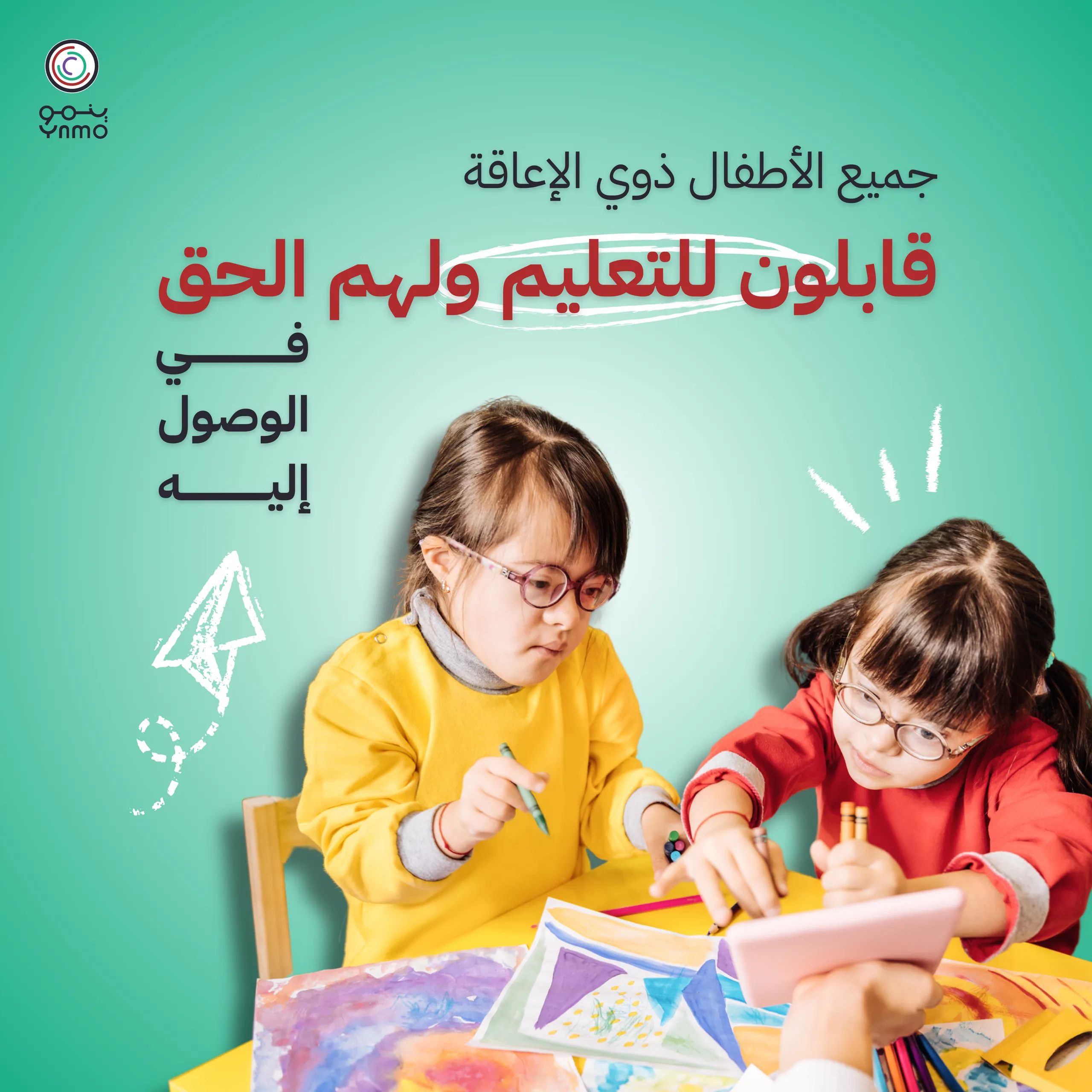
Experiences and studies have proven that all children, including children with disabilities, possess the ability to learn in ways and methods suited to their individual needs. Education is not a luxury or a privilege; rather, it is a fundamental right guaranteed by international conventions, such as the Convention on the Rights of Persons with Disabilities, signed by the Kingdom of Saudi Arabia, which stipulates the necessity of ensuring inclusive education for all without discrimination.
The Importance of Assistive Technology
Technology can play a pivotal role in supporting the education of children with disabilities. Tools such as tablets, customized educational software, and assistive devices like screen readers can be a practical solution to empower children to participate fully in education. Technology is not merely a means of support, but a tool to empower these children to achieve their academic independence.
The Role of Family and Society
The active role of families in supporting children with disabilities is no less important than the role of educational institutions; therefore, community awareness of the importance of inclusive education fosters societal acceptance and positive engagement with children with disabilities. Thus, involving the family in the educational process contributes to boosting confidence and developing the children's skills.
Developing the Educational Environment
Alongside curricula and training, providing an adapted educational environment that includes accessibility facilities (such as elevators and ramps) and a supportive psychological environment (such as anti-bullying policies) contributes to achieving success. Schools must be places that embrace all children regardless of their abilities, while providing teachers with the necessary training to understand the abilities of children with disabilities and work with them to achieve their full potential.
Successful Global Models
Because the concept of equity in education is a project capable of success and flourishing, we can point to successful global examples and models in implementing inclusive education, such as the experiences of the United States, the United Kingdom, Australia, and Finland, and how they achieved the inclusion of children with disabilities within their educational systems. The inclusion rates in education were as follows:
1. United States:
- Legal Framework: Individuals with Disabilities Education Act (IDEA).
- Placement Options: General classrooms (63%), resource rooms, specialized schools, and homeschooling.
2. United Kingdom:
- Legal Framework: Children and Families Act (2014), Special Educational Needs (SEN) Code of Practice.
- Placement Options: Mainstream schools (71%), special schools, and pupil referral units.
3. Australia:
- Legal Framework: Disability Standards for Education (2005).
- Placement Options: General classrooms (89%), support units, and specialized schools.
This is nothing but a clear indication proving that inclusive education is not only possible, but also effectively applicable when the will and resources are available.
The Importance of Legislation and Government Support
Through Vision 2030, the Kingdom of Saudi Arabia is keen on moving forward and aligning with global efforts to promote inclusive education and equality. However, there remains a need to intensify efforts to ensure that children with disabilities have access to mainstream schools rather than being isolated in separate centers or programs. Integrating children with disabilities into society is a tool to empower them to reach their full potential and contribute to building their nation.
This goal can be achieved by developing policies and curricula and providing the necessary resources to support inclusive education. Teachers must also be provided with the necessary training to understand the needs of children with disabilities and embrace diversity in classrooms, in addition to changing misconceptions, beliefs, and negative perceptions, and believing that every child is capable of learning given the right opportunity.
Conclusion
Children with disabilities are not an isolated group from society; rather, they are an integral part of it. Therefore, abandoning outdated classifications and adopting a comprehensive vision grounded in rights and equality is the path to building a cohesive society that embraces all its members without exception. Educating children with disabilities is not merely a legal or moral obligation, but an investment in a bright future for all.
Originally published in Arabic. This English version was produced with AI-assisted translation; the Arabic original remains the reference.