

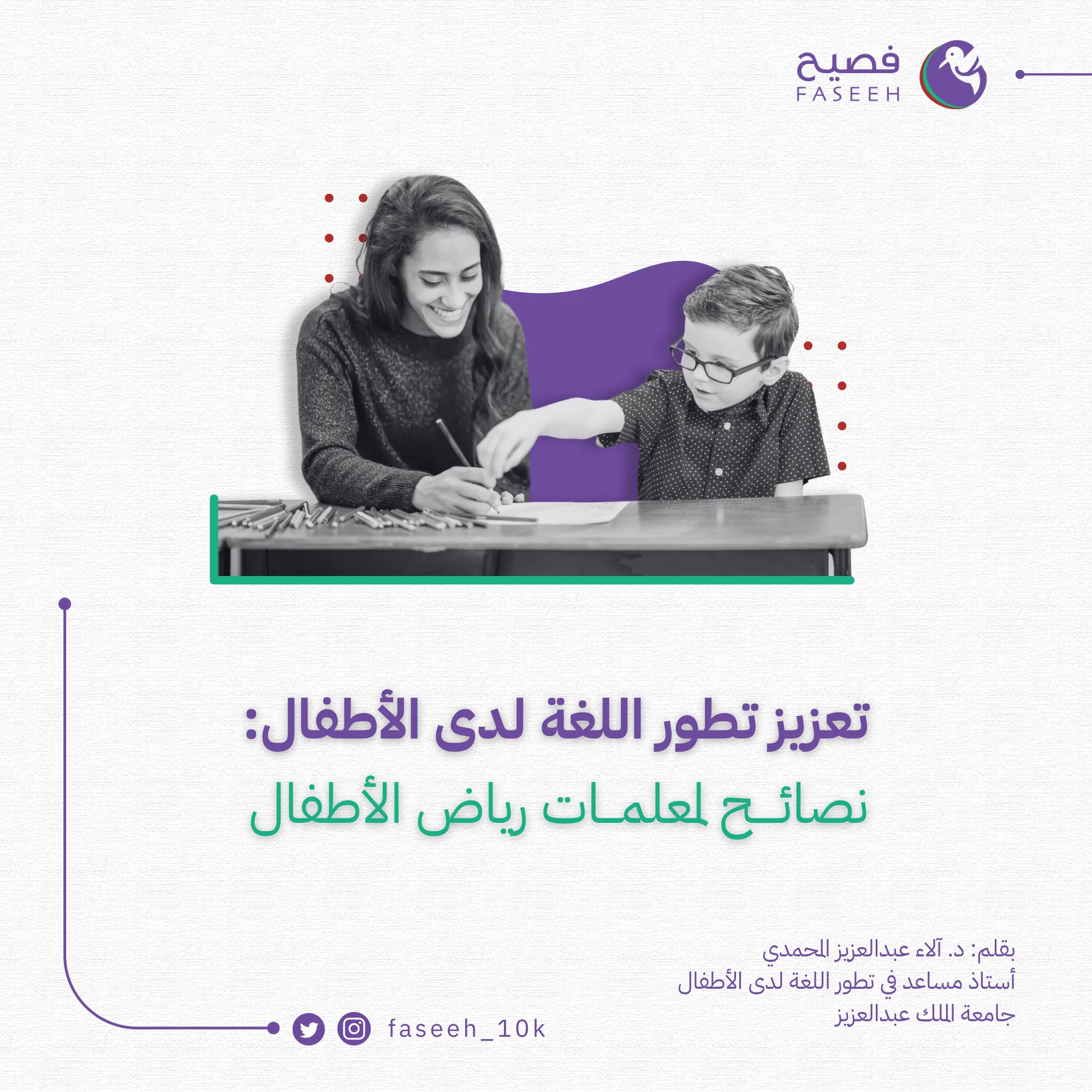
Promoting Language Development in Children: Tips for Kindergarten Teachers
July 12, 2023
Dr. Alaa Abdulaziz Almohammadi
Assistant Professor of Child Language Development
King Abdulaziz University
Language development is an essential part of early childhood education and the foundation for building linguistic knowledge that enables children to acquire knowledge in later school years. Language skills also play an important role in social, emotional, and cognitive development. Therefore, the kindergarten teacher is someone with a major impact on young children's language development. In this important period of a child's life, children acquire foundational language skills and develop their ability to communicate socially and express themselves. It is the kindergarten teacher's responsibility to foster this development and provide a supportive environment that helps children learn language and use it with confidence and skill. In this article, we will address the kindergarten teacher's role in promoting children's language development and the strategies that can support language development in school.
1. Enhancing the classroom language environment
Creating a language-rich environment is one of the teacher's most important tools for promoting language development in children. Classrooms should be filled with words, vocabulary, and sentences appropriate for the children's age. This can be achieved by displaying words, pictures, and drawings in the classroom, labeling objects and activities, and holding conversations that encourage children to engage in discussions. Colors, stickers, and shapes can be used to make the environment more engaging and to encourage children to communicate and use the acquired vocabulary directly and indirectly.
2. Storytelling and interactive reading
Reading and storytelling to children are important tools for language development. The teacher must provide opportunities for children to listen to stories, tales, and chants. A kindergarten teacher should select a diverse set of age-appropriate books that are engaging and rich in vocabulary. Different voices and expressions can be used to tell the story interactively, capturing children's attention and sparking their imagination. The teacher can use some interactive reading strategies, such as pausing in the middle of reading to ask questions, asking children for their predictions about what will happen next, and encouraging them to retell the story in their own words, which enhances comprehension and linguistic expression. Time can also be provided for children to engage in quiet reading on their own, where they explore books and become familiar with words and language rules independently.
3. Active listening and verbal communication
The teacher must be an active listener to children in kindergarten and encourage them to communicate verbally. One must listen to children when they begin speaking with attention and respect. The teacher can use questions and inquiries to guide children and motivate them to express their thoughts and feelings through language. The teacher can also model correct and clear verbal communication by using phrases and sentences suitable for the children's age. This may seem obvious, but it is important to talk to children and interact with them throughout the day, even if it is only about what they are doing or what they see. Simple, clear language should be used with repetition of words and phrases.
4. Providing interactive language activities
The teacher can foster children's language development by providing interactive language activities. Group discussions around a specific topic can be organized, and interactive educational tools such as pictures, flashcards, and games can be used to teach new vocabulary and concepts. Pretend play and simulation can also be organized to enhance language skills, communication, and vocabulary expansion.
5. Enhancing communication between the school and children's families
Collaborating with parents is an essential part of the kindergarten teacher's role in promoting children's language development. The teacher must work to engage parents in the language learning process. Workshops for parents can be organized to present home strategies that promote children's language development in their daily lives. They can also encourage parents to read with their children, engage in conversations, and expose them to diverse language experiences. Regular communication and collaboration with families creates an integrated approach to supporting children's language development.
6. Paying attention to children who need special attention
Every child has individual needs in language development. Kindergarten teachers should monitor and assess children's language skills to identify areas that need additional support. They can provide targeted assistance to meet each child's specific needs. They can also collaborate with speech-language pathologists when necessary to address language delays or specific language disorders.
The role of the kindergarten teacher in promoting children's language development is essential. By creating a language-rich environment, practicing active listening and verbal communication, providing opportunities for reading and listening, offering interactive language activities, and working together with parents, the teacher can make a significant contribution to promoting children's language development. The teacher must be a role model for children and a source of inspiration for them to explore and use language with confidence and skill.
Originally published in Arabic. This English version was produced with AI-assisted translation; the Arabic original remains the reference.