

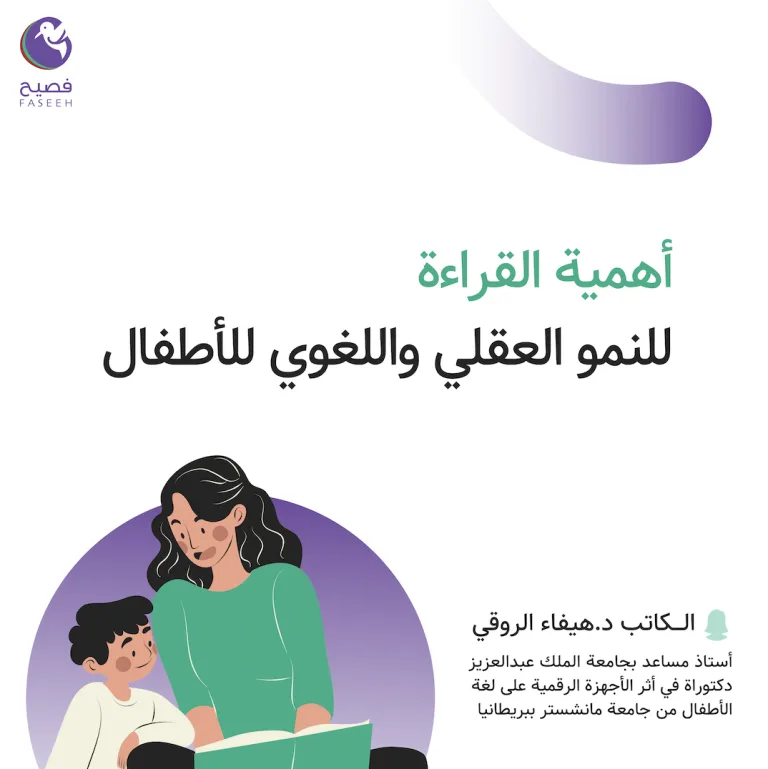
The Importance of Reading for Children's Mental and Language Development
January 15, 2023
Written by: Dr. Haifa Alroqi
Assistant Professor at King Abdulaziz University
PhD in the impact of digital media on children's language from the University of Manchester, UK
The early years of a child's life constitute an important period for their mental and language development, and early experiences during this stage play a significant role in the organizational and functional development of the brain. Therefore, the daily habits and practices that punctuate a child's day have the greatest impact on their growth and the development of their various skills. Reading to children from an early age is considered one of the most beneficial practices for children's mental and language development; reading stimulates the child's curiosity for knowledge and strengthens their memory, exposes children to new experiences, concepts, and words they might not encounter in their daily lives, and accustoms them to the skill of listening—a skill they must master when entering nursery or kindergarten and engaging with larger social settings that require adherence to structure and routine.
Early reading to children is one of the most important factors for success in mastering reading skills in the first three primary grades. Mastering reading in the early school years is vital, as reading difficulties in the primary stage are associated with learning difficulties and academic failure in later years. The American Academy of Pediatrics points out that children who read proficiently in third grade achieve higher high school outcomes and greater career success (Council on Early Childhood, High, & Klass, 2014).
Despite the importance of reading to children from an early age, reading rates for young children in the Kingdom of Saudi Arabia are low. A study we conducted indicates that 60% of Saudi children aged 1–3 years included in the study are never read to, and more than 50% of them do not have more than two children's books at home (Alroqi, Serratrice, & Cameron-Faulkner, 2022). These figures are concerning, especially when compared to children's reading practices in other countries, where reports indicate that more than 50% of children under eight in Britain read or are read to daily (Kucirkova & Littleton, 2016), and half of children between the ages of 2 and 4 in the United States of America are read to daily by their parents (Rideout, 2017).
How do children who are read to stand out from others?
Children whose parents start reading to them at an early age and who are read to more often enjoy:
- A richer and more diverse vocabulary
- Higher reading and writing skills
- More complex and varied sentence structures
- Greater love and enjoyment of books and reading
- A closer bond with parents
- Greater school readiness
- Higher attention and concentration
- Higher scores on measures of social, cognitive, linguistic, and emotional development
The impact of reading on a child's mental development
Research indicates that the more we read to a child, the greater the capacity of neural connections in the child's brain to grow and connect. Studies have also found that reading books and bedtime stories to children in the early years and talking with them from birth increases their mental strength and prepares them for school success in later years. In a study using magnetic resonance imaging (MRI), researchers found that areas in the left hemisphere of the brain become active when reading to children aged 3–5 years, including regions responsible for understanding word meanings and comprehending narrative and imagination (Hutton et al., 2015). In a recent study, the amount of reading to preschool children was associated with an increase in what is known as microstructural integrity in the brain's white matter, which supports the development of language skills and early learning and literacy skills (Hutton et al., 2020).
The impact of reading on a child's language development
Language development is at its fastest stage during early childhood. Language growth helps the child express themselves, form social relationships, and interact with those around them, as well as facilitating the child's mental and cognitive development. Many specialists consider reading the second-best activity for stimulating language growth after direct communication with the mother, and they advise parents to read to the child from the very first months. Although newborns may not understand what the mother reads to them, her voice is enough to stimulate their curiosity about letter sounds and develop their auditory skills. One study indicates that shared reading with children at 8 months of age is positively associated with higher expressive language skills later at 12 and 16 months (Karrass & Braungart-Rieker, 2005). The age at which shared reading practice begins is also—according to several studies—one of the most important factors in the development of oral language skills at age two (Debaryshe, 1993), as well as expressive vocabulary growth at age four (Payne, Whitehurst, & Angell, 1994). Another study indicates that children who were read to regularly at 6 months of age had a 40% vocabulary increase at 18 months, compared to a 16% increase in children who were not read to at 6 months (High et al., 2000). Not just reading, but studies have also found that turning pages and exposure to letters and printed texts are positively associated with the growth of receptive vocabulary that the child understands, and with learning literacy fundamentals (Bus, van IJzendoorn, & Pellegrini, 1995; Mol & Bus, 2011).
Scientific explanations for the effects of reading on child language
Scientific explanations for the effects of reading vary; some see it as an opportunity for joint attention (Joint Attention), which is one of the most important phenomena linked to cognitive, social, and language development. Others attribute the positive impact of reading on language development to what books offer: new words, broader and more diverse vocabulary, and sentence structures that are more varied and complex than the sentences children might hear in daily life, as well as pictures of objects and depictions of experiences they may not see or live in their daily lives. In a study by researcher Erika Hoff, she analyzed maternal speech in four communicative contexts: reading books, dressing the child, mealtime, and during toy play, finding that maternal speech during reading was the richest in vocabulary diversity, highest in sentence structure complexity, and highest in the proportion of topic-related responses (Hoff-Ginsberg, 1991).
Shared reading is also an opportunity to open topics between the caregiver and the child; children benefit not only from the words on book pages, but also from the dialogue between caregiver and child during the reading activity and from the conversation resulting from the caregiver's attempt to convey the text's meanings to the child. Stories and books also provide rich materials that inspire parents to talk with the child about various concepts, giving them the chance to point to new letters and words or discuss other linguistic elements derived from the book (Liebeskind et al, 2014). A child learning through shared reading is not surprising, as children learn optimally when engaging with a more knowledgeable person who scaffolds their access to new content and concepts (Liebeskind et al, 2014).
Researchers believe that reading impacts the quality of the reader's speech and consequently on the child's language development, for when reading interactively to children, the mother or teacher:
- Uses a broader vocabulary
- Uses more complex and varied sentences
- Talks about language
- Directs the child's attention to illustrations and names them
- Encourages the child to reply and respond
- Asks questions
- Answers the child's questions
- Provides confirmation of the child's responses
The caregiver also exhibits verbal behaviors during reading that help achieve learning outcomes in children beyond what they achieve on their own, such as introducing new words, incidental (indirect) teaching of letters and words, and pointing to written text. Each time the same story or book is reread, these verbal behaviors are repeated and reinforced.
Whatever the child's age, reading is an opportunity for cuddling and bonding with children. Including reading as part of the child's daily routine from the beginning makes the child associate reading and books with pleasure, making it a natural and familiar part of their day. Investing in books is an investment in our children's minds and futures, and reading with them is a precious opportunity to draw closer together, creating quality moments that remain in their memory forever.
Is your child's language delayed compared to their peers?
Assess your child's language development level now and book a session with a specialist!
References:
Alroqi, H., Serratrice, L., Cameron-Faulkner, T. (2022). The association between screen media quantity, content, and context and language development. Journal of Child Language, 1-29.
Bus, A. G., van IJzendoorn, M. H., & Pellegrini, A. D. (1995). Joint book reading makes for success in learning to read: A meta-analysis on intergenerational transmission of literacy. Review of Educational Research, 65(1), 1-21.
Council on Early Childhood, High, P. C., & Klass, P. (2014). Literacy promotion: an essential component of primary care pediatric practice. Pediatrics, 134(2), 404–409.
Debaryshe, B. (1993). Joint picture-book reading correlates of early oral language skill. Journal of Child Language, 20(2), 455-461.
High, P. C., LaGasse, L., Becker, S., Ahlgren, I., & Gardner, A. (2000). Literacy promotion in primary care pediatrics: Can we make a difference?. Pediatrics, 105(4 Pt 2), 927–934.Hoff-Ginsberg, E. (1991). Mother-child conversation in different social classes and communicative settings. Child Development, 62(4), 782–796.
Hutton, J. S., Horowitz-Kraus, T., Mendelsohn, A. L., DeWitt, T., Holland, S. K., & C-MIND Authorship Consortium (2015). Home Reading Environment and Brain Activation in Preschool Children Listening to Stories. Pediatrics, 136(3), 466–478.
Hutton, J. S., Dudley, J., Horowitz-Kraus, T., DeWitt, T., Holland, S. K. (2020). Associations between home literacy environment, brain white matter integrity and cognitive abilities in preschool-age children. Acta Paediatr. 109, 1376– 1386.
Karrass, J., & Braungart-Rieker, J. M. (2005). Effects of shared parent-infant book reading on early language acquisition. Journal of Applied Developmental Psychology, 26(2), 133–148.
Kucirkova, N., & Littleton, K. (2016, February). The digital reading habits of children: A national survey of parents’ perceptions of and practices in relation to children’s reading for pleasure with print and digital books. http://booktrustadmin.artlogic.net/usr/resources/1407/digital_reading_survey-final-report-8.2.16.pdf
Liebeskind, K. G., Piotrowski, J. T., Lapierre, M. A., & Linebarger, D. L. (2014). The home literacy environment: Exploring how media and parent–child interactions are associated with children’s language production. Journal of Early Childhood Literacy, 14(4), 482–509.
Mol, S. E., & Bus, A. G. (2011). To read or not to read: A meta-analysis of print exposure from infancy to early adulthood. Psychological Bulletin, 137(2), 267–296.
Payne, A. C., Whitehurst, G. J., & Angell, A. L. (1994). The role of home literacy environment in the development of language ability in preschool children from low-income families. Early Childhood Research Quarterly, 9(3–4), 427–440.Rideout, V. (2017). The Common Sense census: Media use by kids age zero to eight. San Francisco, CA: Common Sense Media. https://www.commonsensemedia.org/sites/default/files/uploads/research/csm_zerotoeight_fullreport_release_2.pdf
Originally published in Arabic. This English version was produced with AI-assisted translation; the Arabic original remains the reference.