

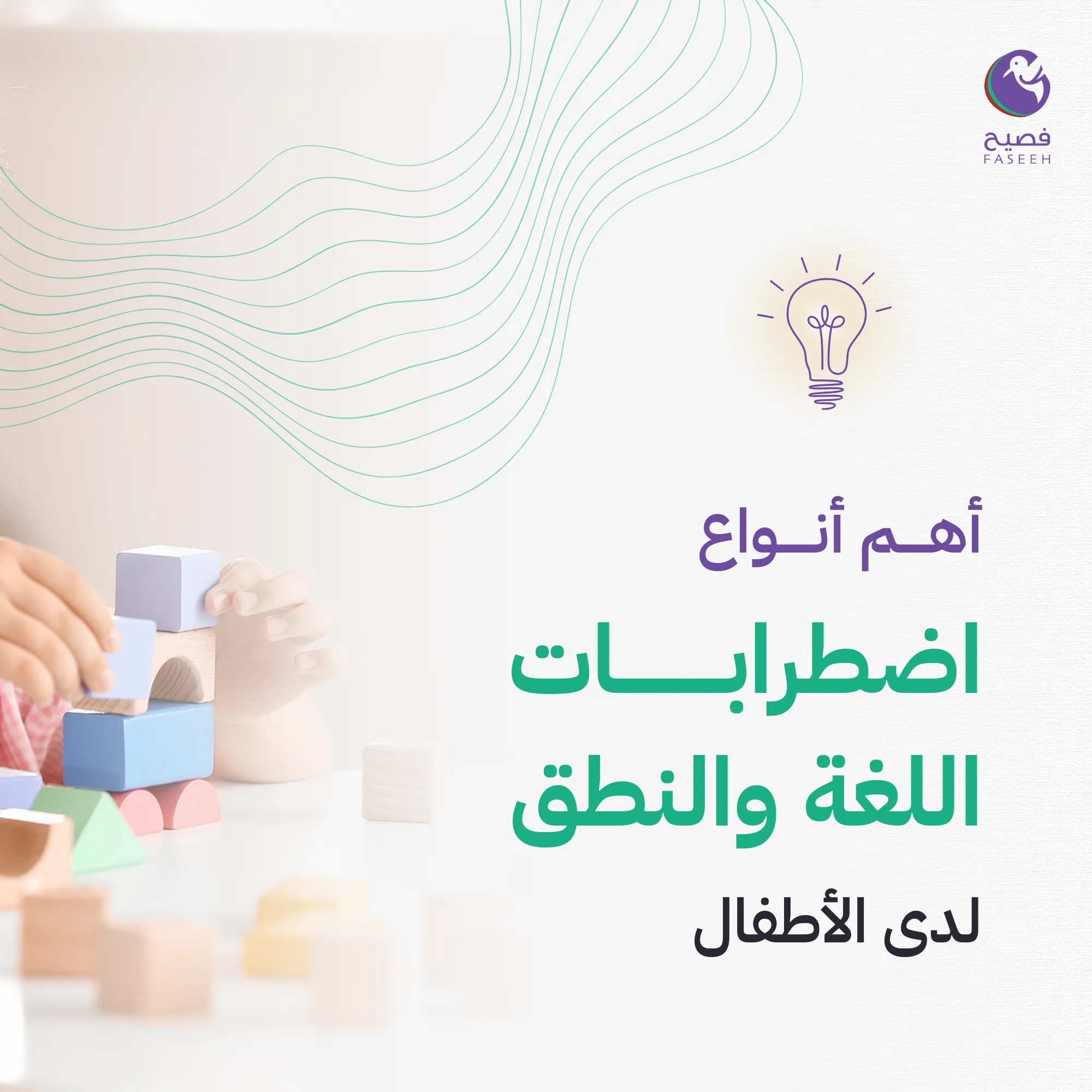
The Main Types of Speech and Language Disorders in Children
November 28, 2022
Speech disorders affect a child's ability to form the sounds that allow them to communicate with others, whereas language disorders affect a child's ability to learn words or understand what others say to them. Speech disorders can affect people of all ages.
Language Disorder
A communication disorder characterized by impaired comprehension and/or impaired use of spoken, written, and/or other symbol systems. This disorder may involve one or all components of language, which include form (phonology, morphology, syntax), content (semantics), and the functional component of language (pragmatics) (ASHA, 1993)
. Individuals with a disorder across language domains experience difficulties in acquiring and developing their language, which may require various interventions including language, cognition, academics, etc.
Types of Language Disorders:
1. Developmental Language Disorder (Developmental Language Disorder)
Developmental language disorder is a subtle yet very common disorder. A child with this disorder has difficulty using and/or understanding language, and their language abilities lag behind other children their age, although they are often otherwise typically developing and do not have other disorders such as autism. Having a language problem means that children may struggle to socialize with their classmates and learn at school.
2. Acquired Language Disorder
This disorder is characterized by a clear decline in language abilities from an individual's previous level, and is thus viewed as a disruption of a system that has already been successfully developed. It varies in severity and differs in the language areas affected.
3. Specific Language Disorder (Specific Language Disorder)
A language disorder in children who are otherwise typically developing, although some may have subtle cognitive deficits. Different language skills may be unevenly affected. Pragmatic skills may be better than syntactic and morphological skills, and some believe that specific language disorder has no clear, specific cause.
4. Autism Spectrum Disorder (ASD)
Autism spectrum disorder (ASD) is a neurodevelopmental disorder characterized by deficits in social communication and social interaction, and the presence of restricted, repetitive behaviors. Deficits in social communication manifest in various ways and can include impaired joint attention and social reciprocity, as well as challenges using verbal and nonverbal communication behaviors for social interaction.
Restricted, repetitive patterns of behavior, interests, or activities manifest through stereotyped or repetitive speech, motor movements, or use of objects; inflexible adherence to routines; restricted interests; and hyper- and/or hypo-reactivity to sensory input.
5. Cerebral Palsy
A non-progressive neuromotor disorder caused by damage to a child's brain before, during, or shortly after birth. It is often described as congenital, although damage in general may sometimes occur after birth. Damage to the brain while it is still developing (up to 16 years of age) leads to neuromotor control problems.
Neuromotor control tends to improve with development. It causes speech disorders in many, but not all, cases. The incidence rate is estimated at approximately 2 in every 1,000 births. Cerebral palsy results in a variety of symptoms affecting respiration, laryngeal function, and general neuromotor control. Intellectual disability is associated in about 50% of cases, and it is likely associated with a higher prevalence of hearing impairment, as well as associated with feeding problems in some cases.
6. Traumatic Brain Injury
It may be an open head injury or a closed head injury, occurring when the head moves and strikes an object or when an object moves and strikes the head. This can lead to brain injury. The incidence of traumatic brain injuries is approximately 200 per 100,000 people and it kills about 100,000 people annually, with individuals who survive brain injuries experiencing diverse consequences. The incidence is higher among males than females.
The risk of sustaining a traumatic brain injury is greater for those with a history of it, for children aged 4 to 5 years, and for adults over 75 years of age. Major symptoms of severe traumatic brain injury include restlessness, agitation, disorientation in time and space, disorganized and inconsistent responses, and impairments in memory, attention, reasoning, drawing, naming, and repetition skills.
7. Aphasia
An acquired communication disorder that affects the ability to comprehend and produce language. It occurs secondary to brain damage. Language impairment in aphasia is more prominent than other impairments, and the most common cause of aphasia is a stroke or cerebrovascular injury that deprives the brain of oxygen and causes various brain problems.
Types of Speech Disorders:
1. Articulation Disorders
Articulation disorders are speech disorders characterized by difficulty producing speech sounds correctly. Sounds may be omitted, distorted, or substituted. Articulation problems affect speech clarity depending on the severity of the articulation problem, and articulation problems are frequently associated with language disorders.
2. Fluency Disorder
A fluency disorder is an interruption in the flow of speaking characterized by atypical rate or speed of speech and rhythm, and disfluencies (e.g., repetitions of sounds, syllables, words, and phrases; sound prolongations), which may also be accompanied by excessive tension, speaking avoidance, struggle behaviors, and secondary behaviors (American Speech-Language-Hearing Association [ASHA], 1993)
People with fluency disorders frequently experience psychological, emotional, social, and functional impacts as a result of their communication disorder (Yaruss & Tichenor, 2019a)
3. Stuttering
Stuttering or stammering is the most common fluency disorder. It is an interruption in the flow of speaking characterized by specific types of disfluencies, including repetitions of sounds, syllables, and monosyllabic words, and prolongations of consonants when not used for emphasis.
Children who stutter involuntarily repeat sounds or words. Stuttering symptoms can vary depending on the situation. Stress, excitement, or frustration can also exacerbate stuttering.
4. Cleft Lip and Palate
Cleft lip and cleft palate are congenital structural anomalies caused by atypical embryonic development. Craniofacial variations are the result of an interruption in embryonic development between the 4th and 10th weeks of embryo or fetal growth (Peterson-Falzone, Hardin-Jones, & Karnell, 2010). Clefts are described based on the specific involved organs affected (lip, alveolus, hard palate, soft palate).
Clefts can be isolated and classified (cleft lip only or cleft palate only) or they can occur together. They can be unilateral or bilateral, and they can be complete or incomplete.
The Importance of Early Intervention
Early intervention is the process of providing services and support to infants, young children, and their families when a child experiences or is at risk of a developmental delay, disability, or health condition that may affect typical development and learning. The goal of early intervention is to minimize the impacts of a disability or delay by addressing the specific needs of young children across five developmental domains:
Cognitive and perceptual domain - Communication skills domain - Physical development domain, including vision and hearing - Social or emotional development domain - Adaptive behavior skills domain
If you suspect that your child is experiencing a speech or language delay, you should have them evaluated by a qualified speech-language pathologist. If your child has a language delay, the Faseeh initiative can help them overcome challenges by offering early intervention sessions.
Through the Ynmo Plan app, conduct a language assessment to check on your child's language development, which allows you, if your child is struggling linguistically, to book an early intervention session with a licensed and certified speech-language pathologist for free
Originally published in Arabic. This English version was produced with AI-assisted translation; the Arabic original remains the reference.