

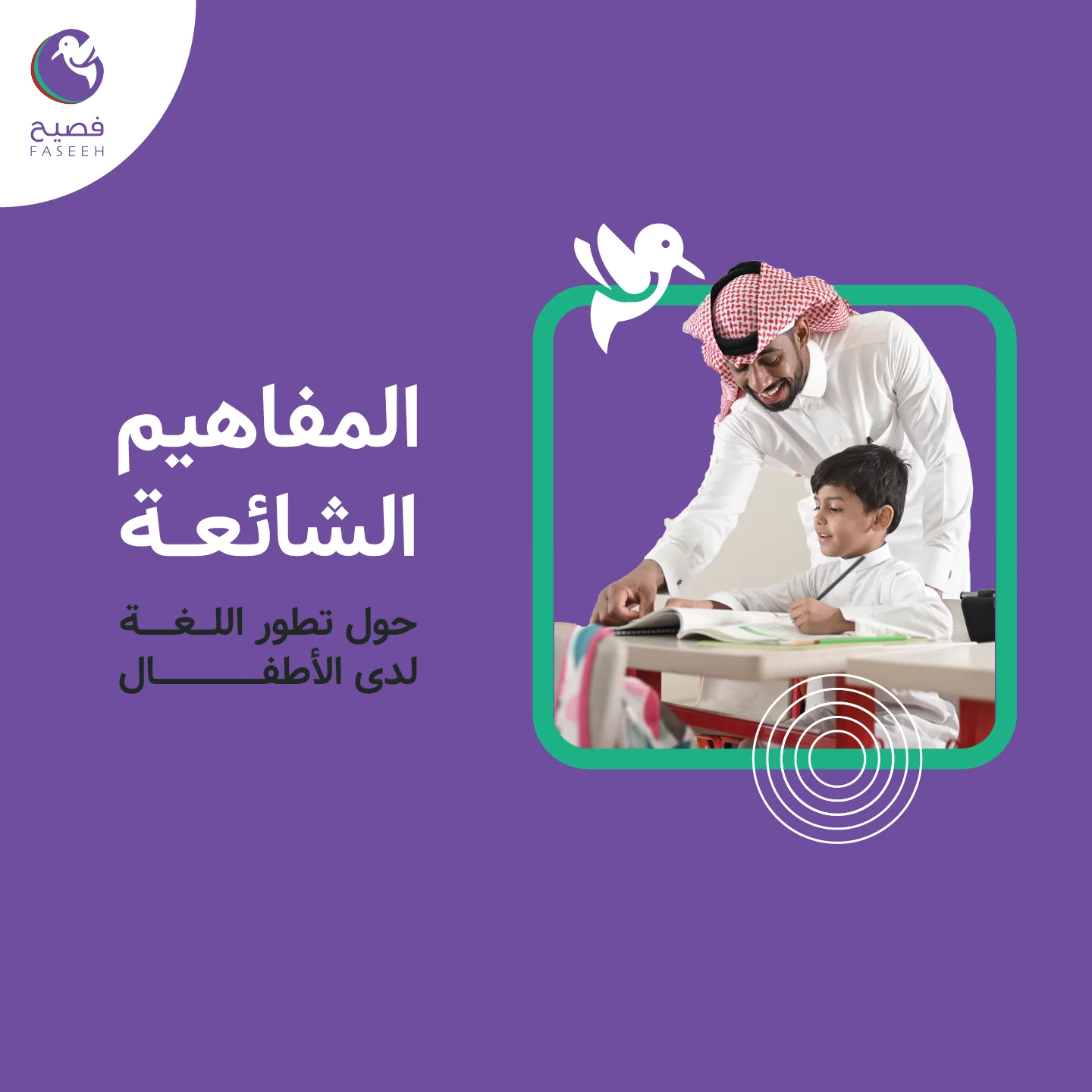
True or False? Common Concepts About Children's Language Development
December 4, 2022
There is a lot of information available on how a child acquires language, but it is important to remember that some common assumptions about children's language development may not always be true. In this part, we address some common concepts about language development and highlight what is true and what is not.
1. We should not talk to children in a simplified way "Baby Talk"
Baby talk refers to the simplified speech pattern that parents use when talking to their young child. It has several characteristics, including: it is slower than talking to adults, contains simple vocabulary and short sentences, includes repetition of vocabulary and emphasis when pronouncing important words, has exaggerated intonation, and is accompanied by positive facial expressions.
Many studies have shown that young children prefer this style of speech and that it increases their attention to speech, especially in the presence of background noise and distracting sounds. "Baby talk" makes it easier for the child to recognize the important words needed to understand what is being said, and also helps in understanding word meanings and then, over time, learning to produce these words. Therefore, do not be afraid to use "baby talk" with your child, as it helps them pay attention to you and to what you are saying.
2. Telegraphic speech helps young children learn language.
Telegraphic speech refers to using isolated words only without adhering to grammatical rules (such as verb conjugations, attached and detached pronouns, and conjunctions). For example: instead of saying "Do you want to go with Dad in the car?", saying "Hammoudi Dad car?" or "Hammoudi go Dad car?", or instead of saying "You have many cars!", saying "Hammoudi manyyy car". Some believe that telegraphic speech makes it easier for children to learn to talk because it allows them to hear only the important words in the sentence. But researchers have a different opinion!
According to expert opinion, telegraphic speech may hinder children's learning of grammar and word meanings, as grammar and pronouns carry meaning as well. For this reason, when you use "baby talk", make sure it is grammatically correct and not disjointed. Try to use simple, short sentences that are grammatically correct. To know whether you are speaking in a telegraphic way, ask yourself if you could say the same sentence to an adult; if the answer is no, then you are using telegraphic speech.
3. Using educational products to stimulate language development in young children
It may be tempting for parents to purchase products marketed as "educational" for young children, but these products are not necessarily effective in helping children learn language.
Many programs and applications aimed at infants and young children are marketed as enhancing skills, including language skills. However, research to date has not found that these programs actually lead to better development of language skills. On the contrary, studies have found that these programs may be associated with a smaller vocabulary size in children who spend long periods watching them, as they may deprive them of opportunities for natural, direct communication with those around them.
Flashcards aim to teach children vocabulary and link it to pictures; however, they may not help children learn the full meaning of a word and how to use it in real-life sentences and contexts. For a child to acquire new vocabulary, they need to be exposed to it in meaningful real-world contexts multiple times before it becomes part of their vocabulary repertoire.
4. Using a pacifier causes speech and language problems
Research to date has not reached a definitive conclusion on this matter. Prolonged pacifier use is associated with dental problems and an increase in ear infections, which in turn negatively affect speech and language. However, findings from studies looking at the relationship between pacifier use and speech have been mixed; some studies indicate no relationship, while other studies indicate that the likelihood of language disorders is higher among children who use a pacifier for three years or more or who suck their fingers frequently.
Many specialists agree that keeping a pacifier in a child's mouth for long periods reduces opportunities for babbling, imitating sounds, and talking with those around them, and therefore advise reducing its use.
5. Girls are faster to start talking than boys
Boys produce their first words and sentences after girls, but gender differences in this regard are only a matter of a few months. There is a normal range for each stage of child language development, but girls tend to be at the beginning of each stage and boys at the end. Thus, boys are not language-delayed, but they reach each stage after girls.
To measure a child's language development, through the Faseeh initiative and in partnership with Al Muhaidib Social Foundation, we developed the Language Development Scale, which enables families to understand the extent of their child's language development, showing results within a few minutes
We also offer, through the Ynmo Plan app, free consultation sessions to assess the child's language status in collaboration with certified centers
Try the Language Development Scale now!
Originally published in Arabic. This English version was produced with AI-assisted translation; the Arabic original remains the reference.