

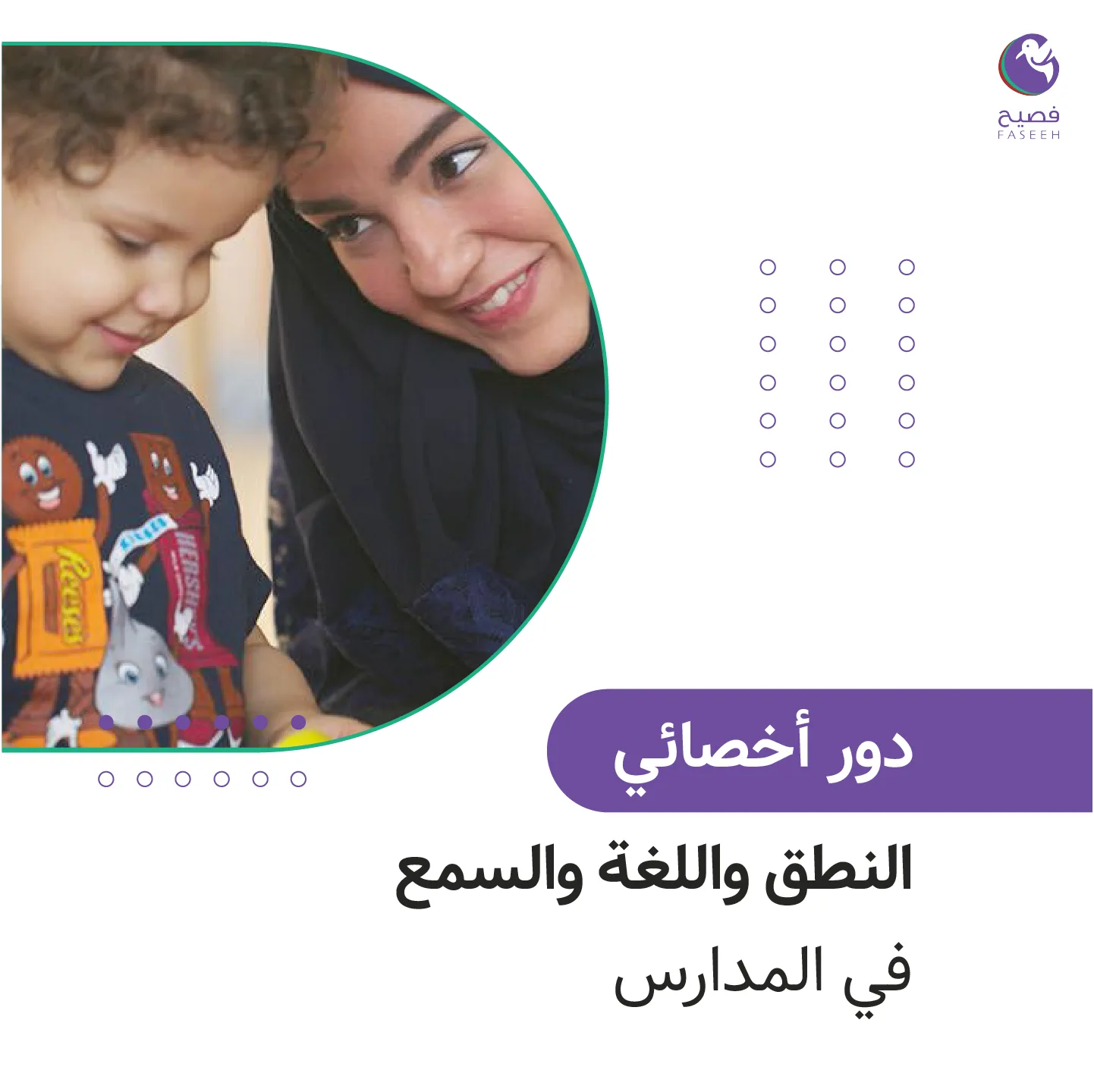
The Role of Speech, Language, and Hearing Specialists in Schools
January 4, 2023
Education occurs through the communication process. The educational process encompasses academic, social, emotional, and vocational performance. The ability to engage in active, interactive communication with peers and adults in the educational environment is essential for students to access education.
Children who have problems with speech, language, and communication skills are at risk of experiencing academic problems, behavioral problems, social problems, and problems with learning skills. Reports indicate that speech and language problems affect 5% to 8% of preschool children and students, and this percentage continues with children into the school stage (US Prevalence Task Force, 2006).
Reports also indicate that one in every 10 children has speech, language, and communication needs, as academic skills, particularly reading and writing skills, directly depend on the integrity of the child's phonological system. For example, phonological skills in children may be considered an important indicator for detecting dyslexia.
Students with speech or language impairments are the second largest category of students after those with specific learning disabilities. Therefore, attention must be paid to speech and language disorders and hearing in children, and screening studies must be conducted to detect these problems and develop treatment plans for them across all educational systems worldwide. Furthermore, communication disorders can severely limit a student's potential future career options.
The relationship between the proficiency and soundness of academic and school skills and the proficiency and soundness of language and communication skills is a direct positive correlation. Reading, writing, gesturing, listening, and speaking are all forms of language. Hence, the integrity of communication skills means the integrity of thinking, reading, writing, conversation, and learning skills. The student needs communication skills to learn, and the better the student's communication skills are, the better their school performance will be. Conversely, weakness in a student's communication skills means weakness in skills of understanding specific classroom instructions, weak participation in classroom learning skills, and weakness in the student's ability to build and maintain new friendships with peers.
Historical Overview:
School-based language programs have a long history, as records indicate that in 1910, Chicago Public Schools was the first school to employ "correction teachers." In the 1950s, speech-language pathologists worked in the school environment and were formerly called "speech correctionists," "speech specialists," or "speech teachers," who primarily worked with elementary school children with mild to moderate speech impairments in the areas of articulation, fluency, and voice. Later, with increased knowledge about language development, Van Hattum, 1982 developed speech therapists' skills in identifying and treating speech disorders, thereby expanding the scope of the profession.
What are the indicators of weak communication skills in school students?
Is your child experiencing speech or language problems? They may not be able to perform grade-level work. They may have difficulty reading, writing, and spelling, and they may not understand social cues, such as what a person means when they nod their head or look away while you are speaking. They may have trouble taking tests and may not want to go to school.
Teachers must pay attention to the following indicators and take appropriate action by referring the student to a speech-language pathologist: speech delay, below-level classroom performance, reading and writing problems, inability of the student to express their thoughts and feelings, difficulty adapting with other students, difficulty understanding others and understanding and following instructions, difficulty understanding exams.
Why is the speech, language, and hearing specialist the most qualified and ideal person to work with students who have language-based learning difficulties?
The speech-language pathologist is the most qualified and ideal person to work with students who have language-based learning difficulties. The reason for this is that the speech-language pathologist possesses specialized scientific knowledge of the development of speech and language skills and linguistic theories, as well as expertise in the fundamental linguistic prerequisites for learning and curricula, such as vocabulary development, knowledge of complex higher language levels (such as figurative language, analogies, linguistic relationships... etc.), grammatical and syntactic skills and their development, sentence reformulation, and comprehension, understanding, and linguistic analysis skills.
The speech, language, and hearing specialist also recognizes the direct impact of language demands on the student's ability to understand curriculum content that requires the following skills in the classroom: open-ended responses, non-concrete (abstract) content, applying and using linguistic information, analyzing and comprehending oral and written information, and summarizing the main points of content.
From here, speech-language and hearing pathologists are trained in methods of assessing, screening, identifying, diagnosing, referring, or counseling individuals who have or are at risk for articulation, language, voice, swallowing, or communication disorders or related impairments. In addition to participating in prevention or eradication activities for communication impairments, speech-language pathologists consult and educate families or professionals about disorders and their management.
The Role of the Speech, Language, and Hearing Specialist in School
Although the mission of speech-language pathologists in schools to improve students' communication abilities has remained constant and their approach relies on determining eligibility, prevention, and assessment, it will continue to evolve. Today, speech-language pathologists serve students with complex communication disorders and difficulties, and this often requires intensive, long-term interventions, as there are many cases of broad language disorders, communication disabilities, and diverse educational needs.
The primary role of the speech-language pathologist is to participate as a team member in identifying students who may need evaluations to determine eligibility for special education or related services. These evaluations help determine the presence of a disability and eligibility/ineligibility for special education and related services under the Individuals with Disabilities Education Act. It is essential that the speech-language specialist is fully aware of state or local education agency laws, policies, procedures, and legal and ethical guidelines when providing assessment and treatment services.
The speech-language pathologist works with students who have problems with classroom activities, academic problems (reading and writing), problems with social interaction skills with their peers, and weakness in learning skills. The speech-language pathologist focuses on integrating communication goals with academic and social goals by working on goal integration within the classroom, helping students understand and use basic language concepts, improving reading and writing skills, and increasing students' comprehension of texts and lessons.
The speech, language, and hearing specialist in the school also helps students maximize their communication skills to support learning. The goal of the school speech, language, and hearing pathologist is to treat or alleviate students' communication problems within the educational environment and improve the degree of student focus on decision-making within the team.
It is also the responsibility of the speech-language pathologist, as part of the team, to assist in interpreting data and results that identify strengths, needs, and emerging abilities; establish the presence of a disorder, delay, or difference, including determining the student's communication abilities in the home and/or community context; determine the degree of severity (when required by state regulations and guidelines or local policies and procedures); determine the relationship between the student's level, language, and communication abilities and any adverse impact on educational performance; and determine whether the disability in communication skills is affected by additional factors that influence the results of assessing these skills. Summarizing assessment results and providing recommendations are among the speech-language pathologist's responsibilities.
The speech, language, and hearing specialist in the school plays an important role in helping the team select, plan, and coordinate the delivery of appropriate services and various scheduling options throughout the duration of service, not just initial decision-making.
If the speech and language pathologist serves as the case manager for any student identified as needing special education or related services, the specialist's responsibilities may include:
• Scheduling and coordinating both school-based and community-based assessments.
• Taking a leadership stance in developing the Individualized Education Program.
• Assisting families in identifying available service providers and advocacy organizations within the community.
• Coordinating, monitoring, and ensuring the timely delivery of special education and/or related services.
• Scheduling and coordinating the re-evaluation process.
• Facilitating the development of the transition plan.
• Coordinating services or providing consultations for students in independent schools and private schools.
The school speech-language pathologist relies on principles of effective intervention when working with students with disorders across all areas covered by the ASHA scope of practice in speech-language pathology (1996), which includes planning, management, implementation, and evaluation of intervention. These general approaches facilitate effective intervention for students.
During intervention, the speech-language pathologist communicates with parents, families, teachers, and other community professionals to reinforce the goals of the IEP / IFSP Individualized Education Program at home and in the classroom, facilitate generalization of communication abilities, and monitor student progress. Speech-language pathologists may also provide information regarding classroom environment characteristics conducive to developing communication skills. They may suggest classroom or individualized accommodations or modifications related to seating and positioning, time requirements, organizational or note-taking skills, assistive technology devices, systems, or services, and materials that may help the student communicate more effectively in the school environment. In short, the role of the speech, language, and hearing specialist in schools centers on improving and enhancing students' communication skills to enable them to participate effectively in all aspects of life and perform their role in society with distinction.
Models and Methods of Delivering Therapeutic Services in School
Selecting the most appropriate and best model for delivering speech, language, and hearing services in school is a flexible process. While no single model is suitable for all students, we must understand the range of service delivery models in addition to the advantages and limitations of each model. A systematic review of research has shown an advantage for classroom-based models where the speech, language, and hearing pathologist and classroom teacher collaborate in teaching language lessons.
There are multiple models and methods used by the speech, language, and hearing specialist in school, among the most important of which are:
1- Tracking / Monitoring
Here, the specialist pulls the student from the classroom for a specific time over nine weeks to ensure the integrity of the student's speech and language skills. The specialist also shares their opinion on the student's communication skills with the teacher and parents, and this model precedes the phase of discontinuing treatment and training for the student.
2- CLASSROOM-BASED
Here, the specialist provides therapy services to the student inside the classroom, and the treatment program may include direct or indirect services through providing advice and guidance. Therapy services through this model in the classroom vary between running and training separate groups, or pulling the student and training them separately. This model may be suitable for students who have language problems and problems with auditory and linguistic processing within the classroom.
3- PULL-OUT
Here, the student is pulled out to the school speech and language clinic, and this model is used in cases where treatment requires individual or small group training.
4- Self-Contained
In this model, the speech-language pathologist acts as the classroom teacher in addition to their role as a speech-language pathologist; thus, they help students improve their academic skills and speech and language skills. This model is recommended for students who have severe speech and language disorders, and with young kindergarten students.
5- Community-Based
This model is implemented and used outside the school, where the speech-language pathologist and classroom teacher accompany the student in outdoor activities to improve the student's life, functional, and practical skills while interacting with the outside environment.
The speech-language pathologist selects the vocabulary the student will use in their interaction, trains them on how to ask and answer questions, and training is also conducted on the sequence of the outdoor activity and details specific to the targeted activity.
6- Combination
Through this model, more than one model is combined; the specialist may use the pull-out model along with the classroom-based model.
7- Consultation/Collaboration
Here, the specialist provides direct and indirect services through personal communication with teachers, parents, students, and others, observation and monitoring, testing, reviewing the student's file, giving a lecture, and providing examples and models.
In conclusion, the central and fundamental role of the speech, language, and hearing pathologist in schools and in the entire educational process is evident, and this role is in no way less important than the role of the Arabic language teacher, mathematics teacher, science teacher, or teachers of other subjects. There is a very pressing need to provide speech, language, and hearing pathologists in every public and private school. Therefore, it is essential for all educational systems in the Arab world to take the necessary measures, legislation, and decisions to ensure the provision of speech, language, and hearing specialists in every school in order to safeguard the education and future of students who have speech, language, and hearing disorders.
Article written by Dr. Yasser Noman Al-Saabi
Director of the Master of Science Program in Speech-Language Pathology and the Bachelor of Science Program in Speech, Language, and Hearing Sciences at Dar Al-Hekma University
References
McKinnon DH, McLeod S, Reilly S (2007) The prevalence of stuttering, voice, and speech- sound disorders in primary school students in Australia. Lang Speech Hear Serv Sch 38(1): 5-15.
McLeod S, Harrison LJ (2009) Epidemiology of speech and language impairment in a nationally representative sample of 4-to 5-year-old children. J Speech Lang Hear Res 52(5): 1213-1229.
US Preventive Services Task Force (2006) Screening for speech and language delay in preschool children: Recommendation statement. Pediatrics 117(2): 497-501.
Originally published in Arabic. This English version was produced with AI-assisted translation; the Arabic original remains the reference.