

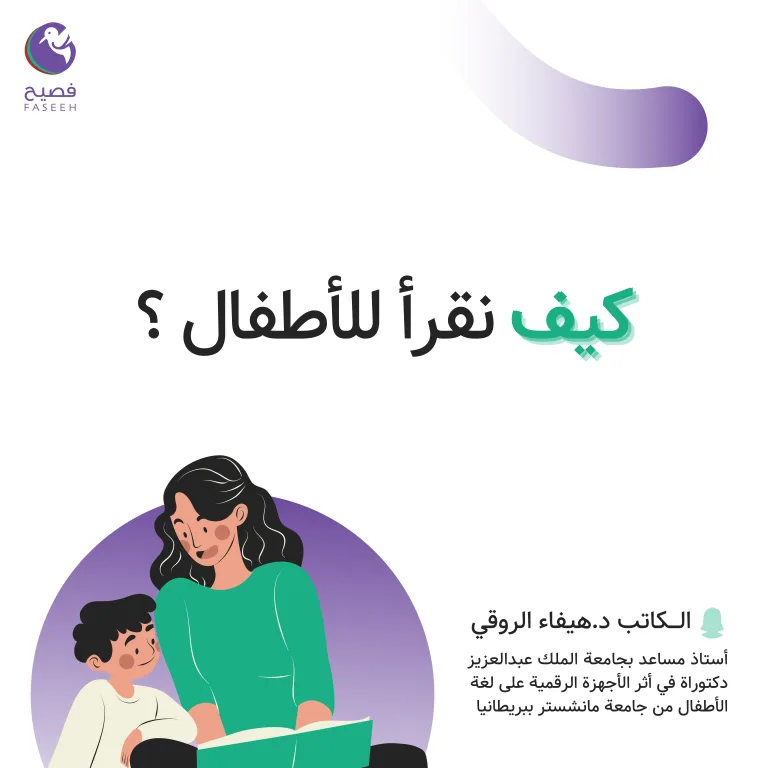
How Do We Read to Children?
January 31, 2023
Dr. Haifa Alroqi
Assistant Professor at King Abdulaziz University
PhD in the impact of digital devices on children's language from the University of Manchester, UK
Reading is one of the most important practices that stimulate language development, but as parents and teachers, we do not all read in the same way. Methods of reading to children vary, and with these differing methods come different expected outcomes. In an article titled "Maximizing the Effectiveness of Reading Aloud," Lane & Wright (2007) indicate that the best positive outcomes from reading aloud were found when applying reading methods and strategies designed by researchers in child development and learning, compared to the outcomes when reading to children randomly.
What does research say about the impact of reading methods on language skill development?
One study indicates that children of mothers who read books to them at ages 2–4 years:
- more interactively
- who asked more questions
- who connected book content to real-life experiences
achieved higher scores on expressive language measures at school age (Britto, Brooks-Gunn, & Griffin, 2006)
Parents or teachers can use specific reading techniques that facilitate the child's language learning and development, including:
- Interaction
- Asking the child questions during reading
- Encouraging the child to ask questions during reading
- Connecting the content of the book or story to the child's real life
- Engaging the child's attention using spoken language and gestures
(Fletcher et al., 2008; Flynn, 2011; Landry et al., 2012; Weigel, Lowman, & Martin, 2007)
In addition to the text expansion technique provided by the reader to the child, such that:
- It supports the development of structures
- It supports the development of semantic comprehension skills
- It leads to an increase in the child's mean length of utterance
(Fletcher et al., 2008; Wasik, 2001; Wasik & Bond, 2001; Yoder et al., 1995)
How do we read to children?
- Choose stories and texts that match what children like and fit their experiences
- For young children, choose books with brightly colored pictures, a clear and simple storyline, cheerful and engaging characters, and simple, stimulating language
- To stimulate language and listening skills, choose books for infants and young children that contain melodies, chants, and repetition
- Read the book first before reading it to the children to ensure its suitability and to plan whether to shorten the story, omit parts of it, or elaborate on other parts, as well as to plan pauses, emphasis points, and places where questions, predictions, or reactions can be elicited
- Plan to give the book or story sufficient time (15 to 20 minutes)
- Give the children some time to sit properly and prepare physically and mentally to listen to the story
- Reading aloud is a skill that few people possess naturally; therefore, practice helps in doing it easily and successfully
- Before beginning reading, tell the children the title of the story, the author's name, and the illustrator's name, even if you have read these details on previous occasions
- When reading a book for the first time, discuss the illustrations and pictures on the cover, and ask the children what they expect the book to be about
- It is very important for the reader to pay attention to their mood and facial expressions before and during reading, as using expressions that suggest authority, such as “Stop moving now and sit properly; pay attention and focus,” does not create an atmosphere that helps the child be receptive and understand
- When reading stories that contain pictures, make sure all children can see the pictures
- Give the children enough time to look at the pictures while reading
- One of the most common mistakes in reading aloud is reading too quickly; read slowly to help children build mental images of what they hear
- Change your voice, tone, facial expressions, and body language as the characters and their emotions change
- Give children an opportunity to connect the book to themselves or their experiences (for example: this book is about a little girl named Layla visiting the zoo; have you ever visited the zoo? Who is the king of the jungle? What is your favorite animal?)
- Encourage children to guess and predict while reading the story
- Help children confirm or revise their guesses and predictions as the events of the story become clearer
- Appreciate all guesses and predictions, not just the correct ones; instead of using words like correct or wrong, use words like (maybe, could be, let's see!)
- Observe your audience. Observe the children's expressions and body language, and look out for signs of lack of understanding or boredom. Based on this observation, modify your reading style, change the book, or prepare them better next time
- Ask open-ended questions at the end of the story where there is no right or wrong answer and the answer is not just yes or no (for example: ask children what they liked about the story, or what they did not like and why). You might also ask for their opinions on the characters, or ask them if the book reminded them of another book or story they heard, or of a personal experience they had
- Point out a part you liked in the book, or ask them about the part they liked or that sparked their imagination
- Remember that some children are not used to listening to stories and may not have yet developed the appropriate abilities and desires for listening. You can keep active children occupied during the story with playdough or paper and pencil to ensure they stay calm and seated during the story.
- Discuss the story with the children, but do not turn the discussion into a test
- Add a third dimension to the story if possible by bringing some items mentioned in it
- Plan time for children to read on their own, even if the experience is simply turning the pages of the book and looking at the pictures
- If a child wants to read to you, it is best to choose an easy book
- Encourage older children to read to younger children
- Let us remember that the most important thing is that we ourselves enjoy reading the story with the children
Dialogic Reading
What is dialogic reading?
It is an interactive method of reading picture books designed to develop children's language and literacy skills
Why dialogic reading?
- Studies indicate the effectiveness of dialogic reading in developing and improving many of children's skills more than regular reading
- Increasing the child's vocabulary and developing their overall language skills
- Supporting spoken language, which in turn supports reading and writing skills in early childhood stages
- Improving oral fluency
- Developing children's descriptive skills
- Increasing children's attraction to books
- Helping adults determine whether the content is understood by the child
- Introducing the basic components of a story (characters, events, outcomes)
Principles of dialogic reading:
Dialogic reading is based on specific rules abbreviated by the words PEER & CROWD
- A. Prompting Prompt
The teacher uses means to prompt children to discuss the book using CROWD prompting methods
- B. Sentence completion Completion
Example: "But she was still ...................... (hungry)" / The cat's name is ...............
- RecallRecall
Example: "Can you remember the first fruit the silkworm ate?" / "What happened to the cat?"
C. Open-ended questions Open-Ended
Example: "My friends.. what do you see in these pictures?"
Who, what, why, where, when questions... Wh-questions
Example: "Why did the silkworm feel better after eating the green leaf? What do you think?" / "Who is this?"
D. Distancing
Children connect the story to their experiences and lives
Example: "Has any of you ever had a stomach ache? Pain in your tummy? Like the silkworm?" "Have you ever seen a lion?"
- Evaluate
The teacher evaluates and comments verbally on the information and responses provided by the children
- Expansion Expand
The teacher expands the child's response by placing the child's word or incomplete sentence into a complete sentence, or using the child's response and adding to it
- Repetition Repeat
The teacher repeats the initial prompt to determine what the child gained from the dialogue
PEER example:
Teacher: What do you see in the picture? What is this? (Prompt)
Children / Child: Monkey / Monkey
Teacher: That's right, it is a monkey eating a banana (Evaluate + Expand)
Teacher: What is this? (Repeat)
Children / Child: A monkey eating a banana
References:
Britto, P. R., Brooks-Gunn, J., & Griffin, T. M. (2006). Maternal reading and teaching patterns: Associations with school readiness in low-income African American families. Reading Research Quarterly, 41(1), 68–89.
Fletcher, K. L., Cross, J. R., Tanney, A. L., Schneider, M., & Finch, W. H. (2008). Predicting language development in children at risk: The effects of quality and frequency of caregiver reading. Early Education and Development, 19(1), 89–111.
Flynn, K. S. (2011). Developing children’s oral language skills through dialogic reading: Guidelines for implementation. Teaching Exceptional Children, 44(2), 8–16.
Landry, S. H., Smith, K. E., Swank, P. R., Zucker, T., Crawford, A. D., & Solari, E. F. (2012). The effects of a responsive parenting intervention on parent-child interactions during shared book reading. Developmental psychology, 48(4), 969–986.
Lane, H. B., & Wright, T. L. (2007). Maximizing the effectiveness of reading aloud. The Reading Teacher, 60(7), 668-675.
Wasik, B. A., & Bond, M. A. (2001). Beyond the pages of a book: Interactive book reading and language development in preschool classrooms. Journal of Educational Psychology, 93(2), 243–250.
Wasik, B.A. (2010). What teachers can do to promote preschoolers' vocabulary development: Strategies From an effective language and literacy professional development coaching model. The Reading Teacher, 63(8), 621-633.
Weigel, D. J., Lowman, J. L., & Martin, S. S. (2007). Language development in the years before school: A comparison of developmental assets in home and child care settings. Early Child Development and Care, 177(6-7), 719–734.
Yoder, P. J., Spruytenburg, H., Edwards, A., & Davies, B. (1995). Effect of verbal routine contexts and expansions on gains in the mean length of utterance in children with developmental delays. Language, Speech, and Hearing Services in Schools, 26(1), 21–32.
Originally published in Arabic. This English version was produced with AI-assisted translation; the Arabic original remains the reference.