

Key Strategies for Developing Child Skills
October 27, 2021
Helping your child acquire desirable behavioral skills is one of the most compelling topics. Whether you are a parent, teacher, or specialist, you are looking for practical steps to teach a child a skill. Here are the key ways to help a child acquire a new skill:
Task Analysis
This is the process of breaking down a complex skill or behavior into small steps. Before teaching a child to acquire a new skill, you should perform the skill yourself or watch someone else perform it so you can understand the steps involved in the process. In this way, you can teach the child to complete each small step until they learn how to do it independently.
For example: you want to teach a child how to wash their hands. After doing it yourself and recording all the steps, you realize that there are 8 steps in this process: 1. The child turns on the water tap 2. The child wets their hands with water 3. The child applies soap to their hands 4. The child rubs their hands with soap 5. The child rinses the soap off their hands 6. The child turns off the water tap 7. The child dries their hands with a tissue or (towel) 8. The child places the tissue in the trash can.
You teach the child the first step; then once they can perform the first step on their own, move to the second step, and continue until they can wash their hands without any help.
Shaping
The child is reinforced for each step that gets closer to the desired behavior.
For example: you want to teach a child who makes some sounds but does not use them in speech to request their daily needs—suppose you want to train the child to ask for the "bathroom." At first, the child will make some unintelligible sounds and try to imitate the parents' speech. The parents will pay attention to those sounds, smile at the child, and cuddle them, which will make the child feel the importance of the behavior they performed. Each time the child makes sounds like "ha," "ma," or "hma" closer to the desired behavior, they will be reinforced.
As a result, the child will begin uttering these words more and more.
There are some guiding steps for shaping, including: 1- Identifying the target behavior 2- Determining whether shaping is the appropriate behavior 3- Identifying the starting behavior or the first behavior, which must be a behavior the individual has already engaged in 4- Selecting the shaping steps 5- Choosing the reinforcer
Note: It may take some time for the child to master the initial behavior in shaping. Take your time with your child! Do not jump into big steps.
Prompting or Assistance
There are several forms of prompting or assistance: full physical assistance, partial physical assistance, full verbal assistance, partial verbal assistance, modeling, and gesturing.
Physical Prompting:
The child has difficulty holding a pencil. You can help them by physically holding their hand to hold the pencil correctly.
Some ways to implement prompting:
1. Most-to-Least
In this method, you proceed by providing a full prompt with the child and offering physical guidance for everything. Then, you gradually reduce the amount of assistance for the child.
For example, teaching a child to wash their hands: at first, you may need to hold their hands and wash them for them. Later, you will gradually move your hands to their elbow, then from the shoulder, and then the assistance will fade away, leading to independence—which is the ultimate goal of teaching a child any skill.
2. Least-to-Most
In this method, you give the child the opportunity to perform the behavior with the least amount of assistance.
For example, during lunchtime, you can place the food on the table for the child and wait for the child to begin eating on their own first. After 5 seconds, if they make no effort to eat their lunch, you can provide verbal instructions: "Eat the rice." If the child still does not respond, you can physically hold the child's hand to hold the spoon, scoop the rice, and place it in their mouth.
Verbal Prompting:
Providing verbal instructions.
For example, to teach a child to read the word "madrasah" (school), you can show the word to them; the child will look at the word, and you assist them by saying "madr"; the child will then read it correctly as "madrasah." Each time, you step back one less part: "mad," then "m." Through these steps, you help your child reach the answer independently.
Modeling:
Video modeling is used to improve social skills and independence in children with autism.
For example: to teach a child how to put on pants, you show them a video clip of a child putting on pants correctly, and the child will imitate this skill.
Gesturing:
This is done by pointing, looking in a specific direction or in a specific manner, or hand movements signaling (prohibition using the index finger).
For example: to teach a child to throw a tissue in the trash can after using it, you point with your eyes toward the trash can so the child goes to discard the tissue in the correct place.
Your proper use of behavior acquisition strategies helps you guide the child to perform the skill with complete independence.
Originally published in Arabic. This English version was produced with AI-assisted translation; the Arabic original remains the reference.
Related articles
Is Your Child’s Language Developing Properly?

The Best Mistake I Made as a Special Education Teacher

The Role of Technology in Reducing Teacher Stress
The Golden Difference in My Students' Lives
How Do We Train Parents in Early Intervention?
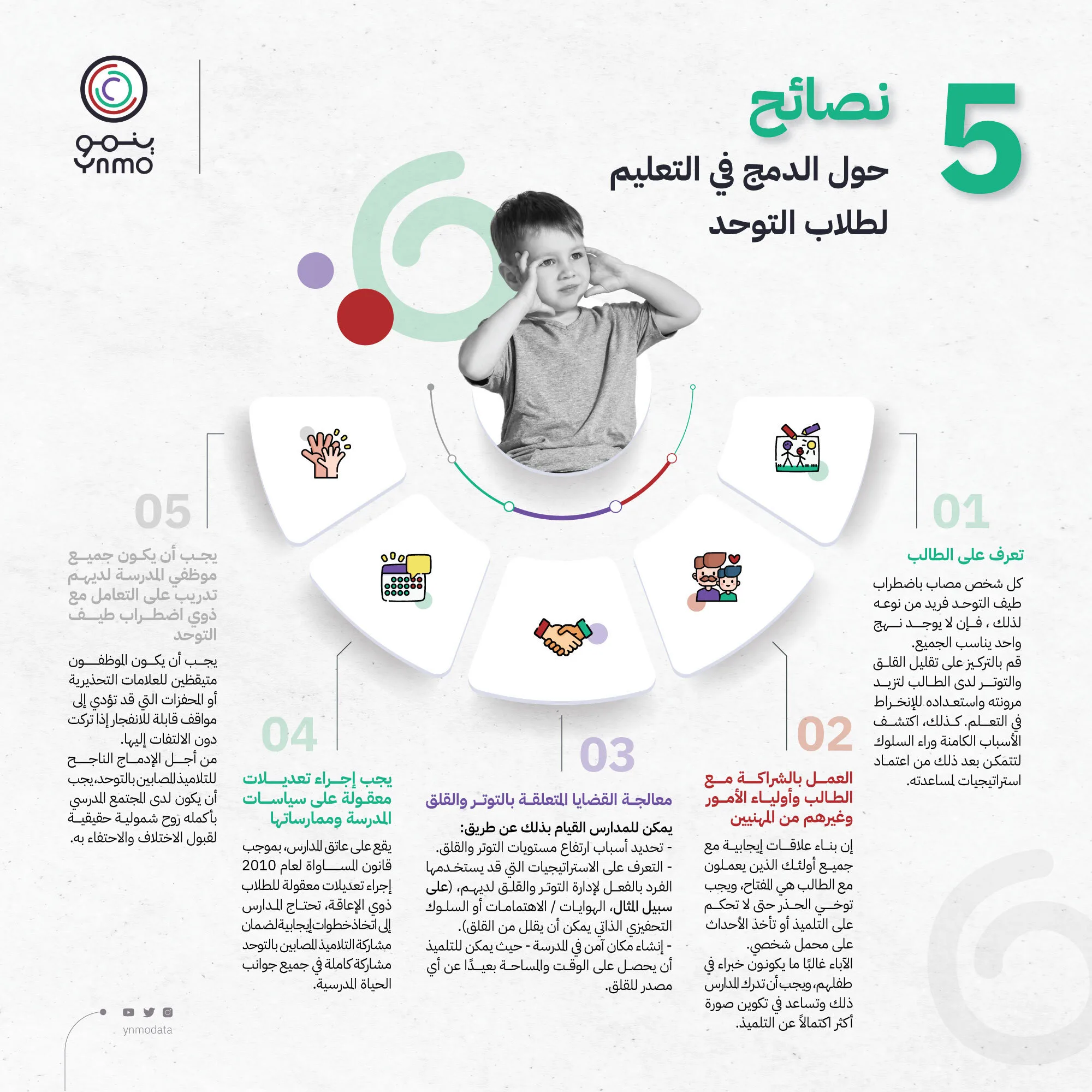
Top 5 Autism Tips: Inclusion in Education