


Autism Spectrum Disorder: Between Scientific Facts and Misleading Claims
May 11, 2018
There are many misleading and erroneous claims circulating about autism spectrum disorder. A large number of these claims have no scientific basis, and many of them have been refuted by studies and research proving the exact opposite. Through this article, we attempt to list some of these claims about autism spectrum disorder and discuss them.
- Is there a medical "pharmacological" treatment for autism spectrum disorder?
It is true that there is no medical "pharmacological" treatment for autism spectrum disorder to date, but early intervention is one of the most important treatments whose effectiveness has been proven by scientific research. The earlier the intervention, the greater the effectiveness through behavioral and educational interventions conducted by competent and trained specialized therapists to help children by developing their linguistic and social skills (3). This is what Dr. Schreibman emphasized when asked about the most effective treatments for autism spectrum disorder in children; her answer was that behavioral therapy helps create positive change and improves the symptoms of autism spectrum disorder (4).
I believe that what makes this misconception grow is the lack of a proper understanding of autism spectrum disorder and the failure to realize that children with this disorder have different abilities like all other children, as a child's response to treatment varies based on a number of variables (the child, the extent of family involvement, the onset of the treatment program, its intensity, etc.). Through these variables, it is difficult to say that there is one treatment or one plan for every child with autism spectrum disorder, because not all children respond to the same treatment plan.
- What is the relationship between vaccines for certain diseases and autism spectrum disorder?
In 1998, British pediatrician Andrew Wakefield and his colleagues published in their study that (the measles – mumps
– rubella vaccine, Measles, Mumps and Rubella) plays a fundamental role in autism spectrum disorder. His study stirred up many fears among parents and the media at the time. In 2010, this study was deemed falsified and fraudulent, and in the same year, this doctor was struck off the medical register and convicted of dishonesty and professional misconduct. We conclude from what is mentioned above that what was said in previous years regarding the link between autism spectrum disorder and vaccines has no scientific basis, and numerous studies have failed to find a link between autism spectrum disorder and vaccines. Furthermore, there are more than 25 studies that refute the link between autism spectrum disorder and the vaccine (1).
- Is there a relationship between autism spectrum disorder and genius?
All people with autism spectrum disorder are geniuses! This idea is considered a "positive misconception" regarding individuals with autism spectrum disorder. This is, as Dr. Lisa says, "and you can imagine how frustrating it can be for parents of children with autism spectrum disorder." Our misunderstanding when describing all individuals with autism spectrum disorder as geniuses may cause many challenges and frustrations for families. This is what Dr. Alison, a research assistant at the University of Connecticut who was diagnosed with autism at the age of three, emphasizes. She says, "We have talent like other people, but to say that all people with autism spectrum disorder are superior in any way is like justifying our existence with other people, where we have to maintain this idea or we won't be desirable!" (1). The bottom line is that individuals with autism spectrum disorder possess different abilities and also different IQ levels. It is not in their best interest for us to generalize this idea; rather, it is better to assess their abilities and find out what skills they lack and need to develop and enhance.
- Is there a relationship between autism spectrum disorder and language?
A study was conducted on 535 children with severe autism spectrum disorder and severe language delay. They found that 70% of these children used sentences by the age of eight, and 47% spoke fluently (2). Based on this study, it can be said that children on the autism spectrum are able to speak, and that the problem is not in autism itself, but rather in the disorders that accompany autism spectrum disorder, such as communication disorder or attention deficit hyperactivity disorder. This was confirmed by Dr. Wodka in a study she conducted entitled Autism Spectrum Disorder Is Not a Language or Speech Disorder, but a Social Communication Disorder. The concept of the importance of communicating with another person is not present among children with autism spectrum disorder. She emphasizes the importance of early intervention because through intervention, children are stimulated to communicate and exchange experiences with others, which may help them improve speech (5). It is not correct to say that individuals with autism spectrum disorder are unable to speak, but rather that autism spectrum disorder may be accompanied by a group of other disorders that may affect speech delay, especially in the first five years of the child's life.
- Is there a relationship between autism spectrum disorder and attention deficit hyperactivity disorder?
In the first years of a child's life with autism spectrum disorder, many syndromes may overlap, such as attention deficit hyperactivity disorder. In 2010, the term (ESSENCE) was created
(Early Symptomatic Syndromes Eliciting Neurodevelopmental Clinical Examinations)
which aims to describe the complexity of developmental problems in childhood disorders before the age of five. There is a close link between autism spectrum disorder and attention deficit hyperactivity disorder. Studies indicate that 30% of the diagnostic criteria for autism spectrum disorder overlap with the criteria for attention deficit hyperactivity disorder. This means that a large number of children with ADHD have a number of autism spectrum disorder traits such as language and communication, impaired social interaction, attention, and repetitive behaviors. It is very important to examine systematically and thoroughly all aspects, whether cognitive, social interactions, attention, and language, and to begin behavioral therapy (2).
- Do individuals with autism spectrum disorder not have feelings?
That individuals with autism spectrum disorder lack emotion or the ability to express their feelings is considered one of the misconceptions about autism spectrum disorder. It is also considered one of the challenges faced by individuals with autism spectrum disorder. The reality is simply that individuals with autism spectrum disorder have difficulty communicating with others and impairments in social communication. Thus, it is difficult for them to convey feelings of sadness and joy. Autism spectrum disorder does not make a person unable to feel the feelings we feel; rather, the problem lies in communicating feelings (6).
References
- Jarrett, C. (2014). Autism-Myth and reality. PSYCHOLOGIST, 27(10), 746-749.
- Hadjikhani, N. (2014). Scientifically deconstructing some of the myths regarding autism. Swiss archives of neurology and psychiatry, 165, 272-276.
- Autism Spectrum Disorder Fact Sheet. (December 06, 2017). National Institute of Neurological Disorders and Stroke.
- Schreibman, L. (2012, April 25). Individualized treatments are future of autism therapies, according to psychologist. American Psychological Association. Retrieved from
- Wodka, E. L., Mathy, P., & Kalb, L. (2013). Predictors of phrase and fluent speech in children with autism and severe language delay. Pediatrics, 131(4), e1128-e1134.
Brewer, R., & Murphy, J. (2016). People with autism can read emotions, feel empathy. Scientific American, 12.
Originally published in Arabic. This English version was produced with AI-assisted translation; the Arabic original remains the reference.
Related articles
Is Your Child’s Language Developing Properly?

The Best Mistake I Made as a Special Education Teacher

The Role of Technology in Reducing Teacher Stress
The Golden Difference in My Students' Lives
How Do We Train Parents in Early Intervention?
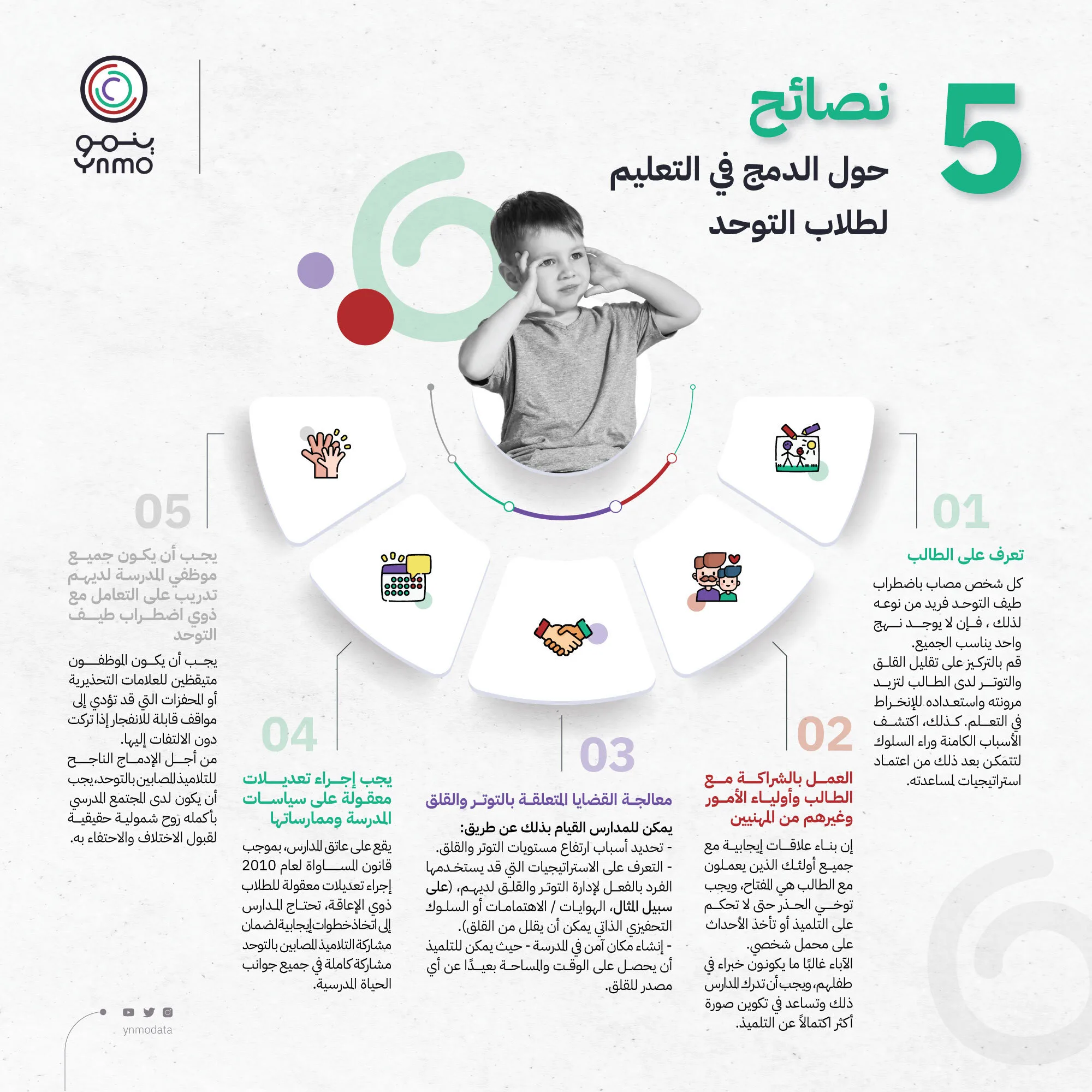
Top 5 Autism Tips: Inclusion in Education