

The Impact of Screen Time on Children's Language Development
November 20, 2022
In our digital era, screens have become an integral part of our lives, and the rapid increase in the use of digital devices has been accompanied by numerous positive and negative impacts on individuals and societies.
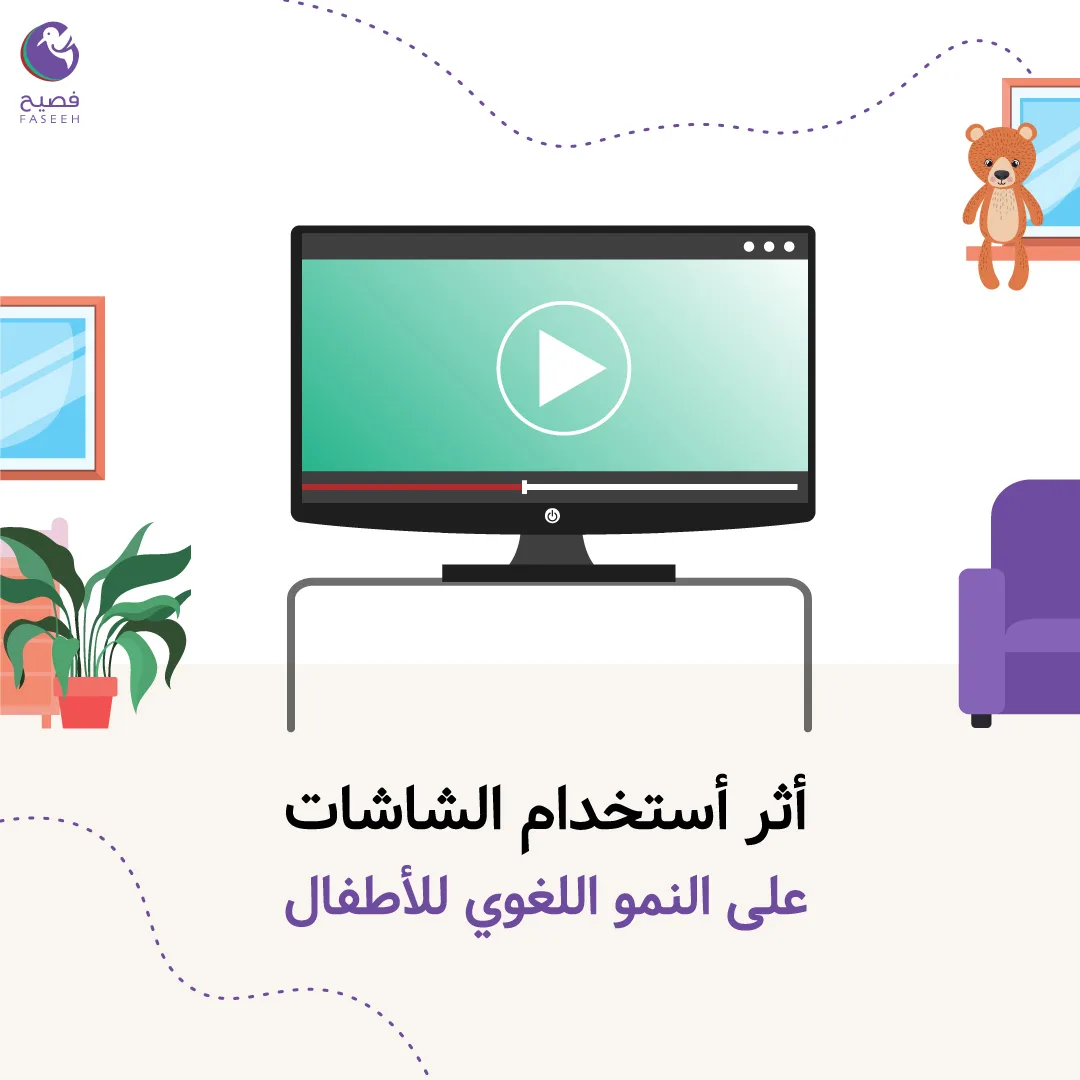
Screens have many effects across various areas, including sleep, weight, academic performance, social skills, and behavior, but our focus here is on language development, especially during the first five years, which represent the golden stage for children's native language development. There is no doubt that language development helps children express themselves, build social relationships, and interact with those around them, as well as facilitating cognitive and intellectual growth.
Some believe that screen radiation is harmful in itself and that this is the reason behind strict recommendations regarding screen use for children under two years old. However, this claim is not supported by scientific research. Rather, what is feared is what is known as the displacement hypothesis, meaning that screen time replaces other, more critical activities for the child, such as sleep, physical activity, talking with parents and siblings, reading, and playing.
Screens and Children Under Two Years Old
Focusing on language development, numerous studies have found a negative correlation between increased screen use and language development in children under two years of age. Research indicates that children at this age do not learn communication skills from screens even when exposed to educational programs, as optimal language acquisition occurs when a child's environment is linguistically stimulating and enriching through direct conversation addressed to them by real people using the native language. In particular, mothers play the most vital role—according to studies—in a child's language development. Mothers and fathers who talk frequently with their children, describe events and objects around them, use varied vocabulary and sentences, expose their children to diverse life experiences, and discuss them with and around the child foster faster and better language development. If screens replace this time, leaving the child occupied with them for long hours and parents distracted from the child, valuable growth opportunities are lost during the critical early years of language development.
Screens and Children Over Two Years Old
As for children between two and five years old, studies have found that they can learn from screens, and screens can offer enriching and enjoyable content if carefully chosen and if usage time is limited to no more than one to two hours per day.
For children over five years old, language development is not at risk from screens. In fact, screens may provide them with opportunities to communicate with others via text and voice, exposing them to content that broadens their horizons and increases their knowledge. This is certainly true when the internet is used safely and the child is educated about the benefits and risks associated with using devices and interacting with others in the digital realm.
Content Quality Is Also Crucial
When discussing screens, many tend to focus on the amount of time children spend using them, but type and quality are equally important. The quality of content children are exposed to plays a major role in their language development. Studies indicate that programs where characters speak directly to the child, encourage them to speak, prompt them to respond, provide opportunities to answer and guess, engage in dialogue among themselves, mimic natural conversation, and offer chances to hear varied vocabulary alongside visual representations of these words are associated with better language development. Unfortunately, however, such high-quality programs represent only a small proportion of the children's programming available in Arabic.
On the other hand, programs that lack language use—such as those relying on meaningless gibberish, silent shows, or those featuring only music—do not enrich a child's vocabulary. This type of content has recently become widespread on YouTube, targeting children worldwide without using a specific language so that viewership is not limited to speakers of that language.
Fast-paced songs where clips transition rapidly and the camera zooms in and out continuously have also become common recently. According to research, this type of content can distract a child's attention and prevent them from learning from the screen. It is a widespread pattern in our Arab region across children's songs on YouTube and television.
A study we conducted revealed that children under three years of age in Saudi Arabia watch non-educational content and children's songs more than educational programming, whereas their peers in the United States watch educational shows more than non-educational ones. This may be due to a shortage of programs with clear educational goals in the children's media landscape across the Arab world.
Many parents settle for whatever content is easily accessible or what comes up during a quick search for children's shows. Therefore, much can be done to provide a beneficial and safe digital experience for our children. Some of this responsibility lies with producers and content creators, and some lies with parents, who are encouraged to make an effort to find and provide suitable content, guiding their children toward it rather than inappropriate alternatives.
Co-Viewing and Its Impact on Language Development
Recent research has shifted toward focusing on how viewing takes place, rather than solely looking at quantity and type. Engaging with young children while watching or playing with digital devices is linked to more positive outcomes for language and social skills compared to isolated screen time.
Naturally, co-viewing television or playing video games together is easier and more common than sharing tablets and smartphones. Co-viewing serves as a form of joint attention, which is one of the most vital practices associated with language growth in children. It also opens up avenues for dialogue between the caregiver and the child regarding the content being viewed, especially when the caregiver uses the opportunity to comment on the material, explain vocabulary, and connect the content to the child's daily life using rich vocabulary and sentence structures that expand the child's knowledge and language.
International Recommendations
Numerous organizations issue recommendations regarding children's screen time, updating them regularly to reflect findings from the latest research on screen use during childhood. Among the most prominent are the guidelines from the American Academy of Pediatrics, which are divided into two categories: one for children under 5 years old and another for children over 5 years old.
American Academy of Pediatrics recommendations regarding screen time for children under 5 years old:
- Avoid the use of digital media for children under 18 months (except for video chatting).
- If parents wish to introduce digital media to children aged 18 to 24 months, high-quality programming should be chosen, and parents should engage with the child during viewing or use.
- Limit screen exposure for children aged 2 to 5 years to a maximum of one hour per day of high-quality content, ensuring co-viewing with the child to help them understand the content and apply what they learn to the real world.
- Avoid fast-paced programs, apps with excessive distracting elements, and content containing violence.
- Turn off televisions and other devices when not in use.
- Avoid using media as the sole method to soothe a child.
- Monitor the content the child views and downloads, reviewing and testing it before the child engages with it.
- Keep bedrooms, mealtimes, and parent-child playtime completely screen-free.
- Turn off screens at least one hour before bedtime and remove all devices from children's bedrooms.
American Academy of Pediatrics recommendations regarding screen time for children over 5 years old:
- Develop a family media use plan that includes:
- The types of content permitted and how they are used, tailored to each child's age and the family's principles and values.
- Setting specific, pre-agreed time limits for use and viewing.
- Ensuring children and teens get the recommended amounts of physical activity (at least one hour) and sleep (8 to 12 hours depending on the child's age).
- Ensuring children do not sleep with devices in their bedrooms, including televisions, computers, and smart devices.
- Stopping all screen exposure one hour before bedtime.
- Avoiding screen use during homework time.
- Designating screen-free times (such as family time) and screen-free zones (such as bedrooms).
- Encouraging activities that stimulate development and build skills, such as reading, talking, and playing together.
- Communicating these rules to other caregivers around the child, such as nannies, domestic workers, and grandparents, to ensure screen time guidelines are applied consistently.
- Selecting content for children and participating with them in playing and viewing.
- Talking with children about digital citizenship and online safety, emphasizing the importance of treating others with respect both in person and online, avoiding cyberbullying and inappropriate messaging, and staying alert against online solicitation and communications that could compromise privacy or safety.
- Establishing a circle of trusted adults (such as relatives) who can connect with the child via social media and whom the child can turn to when encountering challenges.
A Final Word
In our current era, screens have become an inseparable part of daily life, and with the pandemic, they became an essential tool for communication and learning rather than a luxury. Screens are here to stay, so resisting or rejecting them is not the solution. However, this does not mean overusing them, allowing them to displace more critical daily activities and habits, or neglecting to select and monitor content. It is our children's right to be raised in a safe environment that enriches their knowledge and develops their skills, and to grow soundly and live a healthy, balanced life. This is achieved through awareness, dedication, and spending the time needed to understand, manage, and optimally guide their digital environment.
By downloading the Ynmo Plan app, take the initiative in early screening for your child's language and use the language development assessment to track the progress of their language skills.
Download the Ynmo Plan app now!
Dr. Haifa Al-Rouqi
Assistant Professor at King Abdulaziz University
PhD in the Impact of Digital Devices on Children's Language from the University of Manchester, UK
Originally published in Arabic. This English version was produced with AI-assisted translation; the Arabic original remains the reference.