

The Human Capability Development Program and Addressing Challenges Facing Persons with Disabilities in Saudi Arabia
October 14, 2021
Under the umbrella of Saudi Vision 2030 and its ambitious aspirations, the Human Capability Development Program was launched as one of the Vision 2030 Realization Programs. It seeks to ensure that citizens possess capabilities that enable them to compete globally, and the program has included the challenges facing persons with disabilities to work on addressing them.
The committee released the Human Capability Development Program Implementation Plan, which outlines: the program's scope, the program's aspirations, the current state, and the program's strategies and initiatives. The current state assessment process includes analyzing the fundamental stages of capability building: the basic education stage, higher education and technical and vocational training, and lifelong learning, in addition to the current challenges and efforts related to enablers.
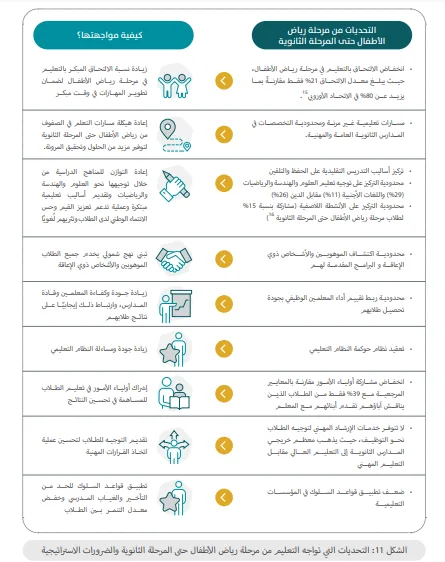
After evaluating the current state, the challenges facing the basic education stage (kindergarten through secondary education) were summarized as follows:
- Low enrollment rate in pre-primary education
- Inflexible tracks and limited specializations
- Outdated curricula and teaching methods
- Limited identification of gifted individuals and persons with disabilities
- Limited alignment of teacher qualification requirements with the quality of performance outcomes
- Complexity of educational system governance
- Low parental involvement
- Limited counseling and guidance
- Weak enforcement of codes of conduct
Regarding the challenge of outdated curricula and teaching methods,
the report indicated that the educational system in the Kingdom still relies on traditional, non-renewed methods and curricula, with little attention and focus on extracurricular, enrichment, and community activities such as volunteering and community service, which contribute to instilling the values of self-reliance, resilience, and adaptability in students. In addition, there is the challenge of a low number of actual school days, which leads to reduced instructional time per subject, alongside the absence of an advanced institutional methodology for updating curricula.
Current efforts are represented in the Ministry of Education's work to roll out a national program to conduct technology development workshops in programming, digital education, and manufacturing across several secondary schools in the Kingdom, in addition to initiating the development of secondary education curricula and including new subjects such as philosophy and critical thinking.
As for the challenge of limited identification of gifted individuals and persons with disabilities,education in the Kingdom faces five main challenges in the special education sector, including:
- Limited early diagnosis and imprecise definition of persons with disabilities in the Kingdom, which leads to a low enrollment rate of persons with disabilities across education stages.
- Curriculum improvement and adaptation to increase the effectiveness of inclusive education for students with disabilities, where improving curricula aims to enhance the effectiveness of fully including persons with disabilities in general education classrooms, taking into account their co-occurring disabilities during development, such as sensory, intellectual, motor, psychological, and social cognitive impairments, speech difficulties, and others.
- Limited teacher training and mentoring in special education specializations, as only about 9% of teachers work in classrooms where 10% of students have disabilities, which is lower than the OECD average of 27%.
- Poor readiness of infrastructure, equipment, and resources needed to meet the needs of students with disabilities, as facilities are not equipped with appropriate amenities such as restrooms, elevators, laboratories, and educational resources suitable for accommodating students with disabilities.
- Absence of a public policy for identifying and nurturing gifted individuals.
Current efforts are represented in the initial shift toward inclusive education, which involves educating persons with disabilities alongside their peers, or in a separate classroom within the same school building, though on a limited scale. Regarding the care of gifted individuals, efforts are reflected in the work undertaken by the King Abdulaziz and His Companions Foundation for Giftedness and Creativity.
Regarding The challenge of low parental involvement
The report indicated a low level of family contribution to children's education compared to benchmark countries, as studies indicate that parents in the Kingdom are less involved in their children's education, with only 39% of parents discussing their children's progress with teachers. Results from the Progress in International Reading Literacy Study (PIRLS) showed that Saudi students with high family involvement scored higher than other students.
Assessing the current state is an essential step in identifying the challenges and opportunities facing the human capability ecosystem. The report explained that this assessment of the current state contributes to setting development priorities and working to transform them into opportunities that support this path in a positive and sustainable manner, in addition to maximizing the positive achievements made over the past period while making the best use of successful experiences from advanced countries in this field regionally and globally.
We are all optimistic about what the Human Capability Development Program has introduced and what it aspires to achieve in adopting new educational methods, committing to improving learning outcomes, engaging parents in the educational process, and ensuring equal educational opportunities for persons with disabilities.
This is what we strive for at Ynmo by developing new digital educational methods that improve the quality of learning outcomes and engage families in the educational process, turning it into a continuous learning journey.
Originally published in Arabic. This English version was produced with AI-assisted translation; the Arabic original remains the reference.
Related articles
Is Your Child’s Language Developing Properly?
The Best Mistake I Made as a Special Education Teacher
The Role of Technology in Reducing Teacher Stress
The Golden Difference in My Students' Lives
How Do We Train Parents in Early Intervention?
Top 5 Autism Tips: Inclusion in Education