


Toilet Training
October 25, 2021
Teaching your child how to use the toilet properly can be a task that takes a lot of time and patience, whether the child has autism spectrum disorder or not. But if your child has autism spectrum disorder, the toilet training process may take longer and involve some specific challenges.
Some appropriate indicators to start toilet training:
- If your child begins to realize the need to go to the toilet.
- If you notice changes in your child's behavior patterns, such as showing distress or distraction when their clothes are wet or soiled.
- If you notice that your child realizes they have started / finished urinating or defecating.
- If your child shows an interest in using the toilet or using it on their own without being asked.
- The child remaining without urinating in the diaper for at least two hours.
- If your child starts telling you with words or gestures when they urinate or defecate in their diaper.
- If your child tells you with words or gestures before urinating or defecating, they are ready for toilet training.
- If they dislike wearing a diaper, perhaps trying to pull it off when it is wet or soiled
Note: It is not required for your child to have all of these indicators.
Things to consider before starting toilet training:
Physical condition: Make sure the child does not suffer from any health problems, for example: bladder or bowel problems, or difficulty controlling elimination. In the presence of health problems, it is recommended to consult a specialist doctor.
Language and communication: Many children with autism spectrum disorder face challenges in understanding and using language. For example: urine - feces - clean - wet - soiled.
Undressing: Some children with autism spectrum disorder find it difficult to pull their pants down or pull them up.
Fears: Some children with autism spectrum disorder fear sitting on toilet seats or hearing the sound of the flush. Your child can get used to the bathroom by using a visual schedule and making it part of
the routine, which helps reduce your child's fears.
Note: Some children with autism spectrum disorder may not realize that they need to go to the toilet or that their clothes are wet or soiled.
Using different toilets: Some children with autism spectrum disorder learn the toilet routine at home or school, but find it difficult to generalize the skill to other places, such as public restrooms.
Starting toilet training:
The tips below can help with toilet training.
Timing:
- Sit your child on the seat at times when you notice they often defecate, such as 30 minutes after eating or after a bath. This does not apply to all children.
- Look for signs indicating that your child needs to go to the toilet — some cues include changes in movement, passing gas, or moving to a different room on their own.
- If your child does not urinate or defecate after 3-5 minutes of sitting on the seat, it is best to stop, because sitting on the seat for long periods may feel like punishment to them.
Encouraging the child:
- Praise your child for trying (even if progress is slow):
You can say, "Well done for sitting on the seat." This lets your child know they are doing a good job.
- Gradually reduce praise as your child masters each part of the process.
- Ask your child at different points throughout the day (but not too often) if they need to go to the toilet.
- If your child misses using the toilet, try not to feel frustrated. Children usually do not have accidents on purpose, so handle the situation positively.
Underwear and clothes
- Stop using diapers (except for sleeping or naps).
- Start using underwear or training pants all the time. You can even let your child choose some underwear, which can be an exciting step for them.
- Dress your child in clothes that are easy to remove — for example: pants with elastic waistbands instead of full-body outfits. In warm weather, you may want to leave your child in their underwear when you are at home.
Hygiene
- Wipe the bottom area until your child learns how to clean themselves. Remember to wipe from front to back, especially with girls.
- Teach your son to control his penis when urinating.
- Teach your child how to wash their hands after using the toilet. This can be a fun activity that your child enjoys as part of the routine.
Remember that using the toilet independently is the ultimate goal and may take several months, but there will be many small steps and successes along the way.
Factors to consider:
- When changing your child's diaper, do so in the bathroom area so they can begin associating toilet activities with the bathroom.
- Your child may behave differently than usual when their routine changes, so let everyone who cares for them know why there might be a change in behavior.
- Make sure everyone working with your child starts toilet training at the same time and follows your agreed-upon approach.
- Observe your child over several days to see when they urinate or defecate. Identifying a regular pattern can help you take your child to the toilet.
- Continue taking your child at specific times based on your observations. If your child wets themselves, take them to the toilet as soon as possible. Ignore accidental wetness or wetting that occurs with your child and handle the situation positively .. and continue the daily routine of your toilet training.
- Use a visual sequence next to the toilet to help your child understand what is expected of them. The sequence can be either in the form of pictures or written words — whichever is more suitable for your child.
- Make sure any pictures or instructions are very clear. Use clear pictures for the child when presenting instructions.
- Show your child a picture or drawing of the bathroom and say "[child's name], toilet", take them to the bathroom, follow the visual sequence to undress them, and sit your child on the toilet seat.
- Determining rewards. Make a list of your child's favorite things, such as foods, toys, and videos. Rewards can be divided into: a reward for going to the bathroom, and a reward after finishing in the bathroom.
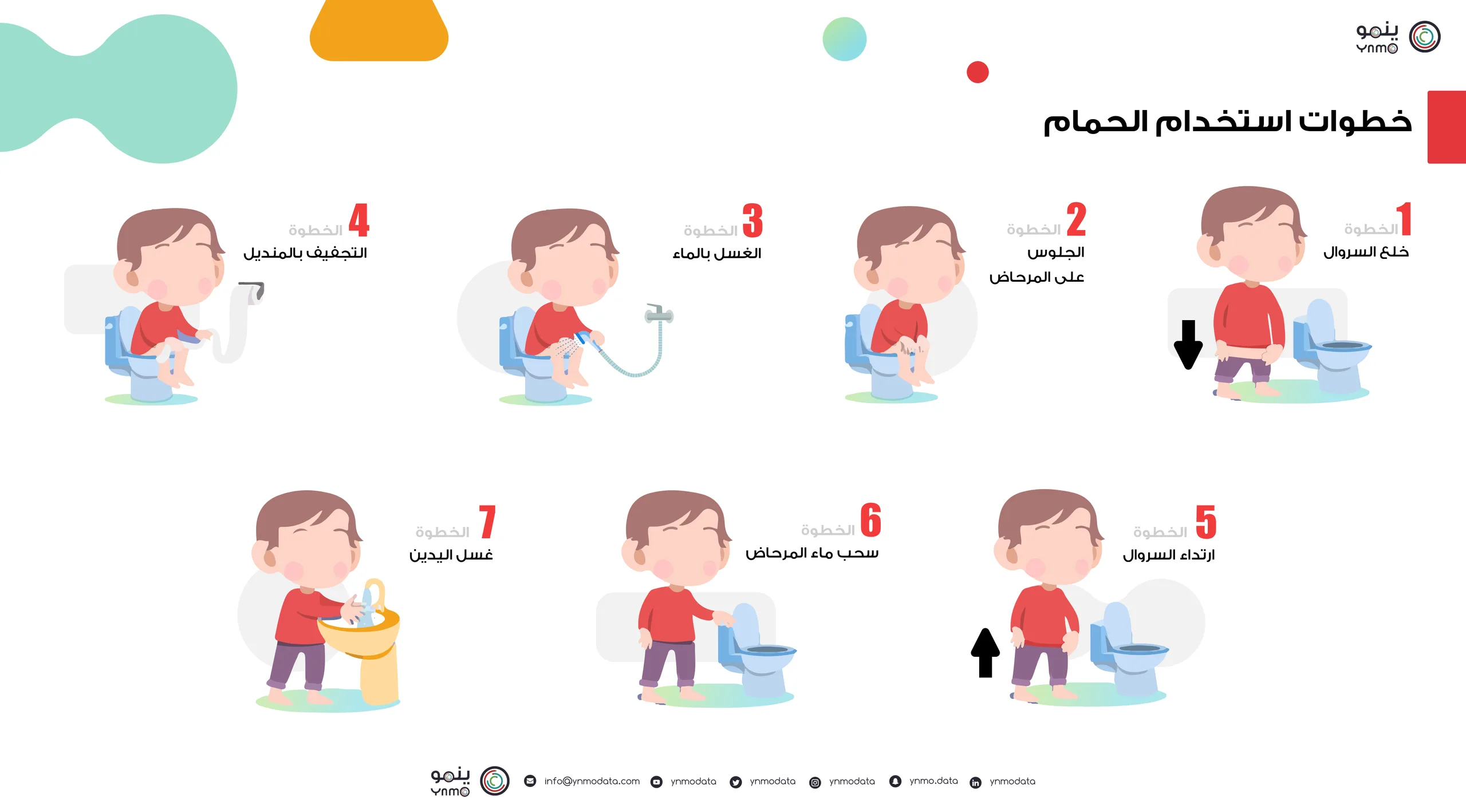
Steps to train a child with autism spectrum disorder to use the toilet:
Sources:
.https://raisingchildren.net.au/autism/health-daily-care/toileting/toilet-training-autism
Originally published in Arabic. This English version was produced with AI-assisted translation; the Arabic original remains the reference.