


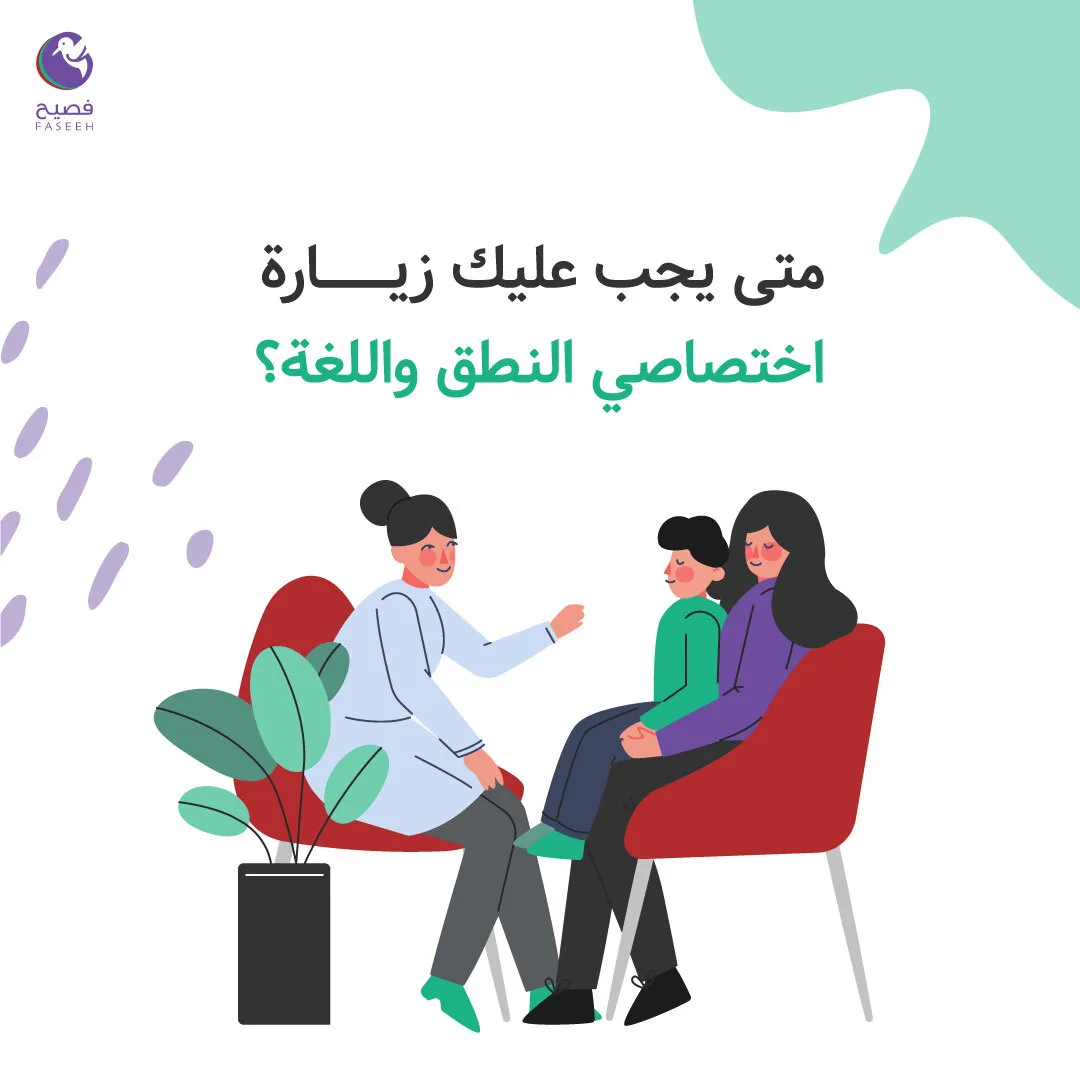
When Should You Visit a Speech-Language Pathologist?
December 14, 2020
Some parents wonder whether or not their child needs to visit a licensed speech-language pathologist. On the one hand, parents may not be able to identify "what is considered a problem, disorder, or delay," and on the other hand, it may be difficult for them to recognize the rehabilitation services provided by a licensed specialist. Among the most prominent questions I often hear from parents are: At what age should I visit a speech-language pathologist? Is there a certain age at which a child is considered too young to visit a speech-language pathologist? If I suspect something, should I wait until they grow older and the symptom disappears without intervention? In answer to these questions, I would like to share with you some signs that parents should pay attention to in order to monitor their children's developmental progress and know when they can seek help from a specialist.
Before we begin mentioning the signs, I would like to emphasize the importance of early intervention. Waiting is not recommended; early intervention benefits the child doubly and reduces the development of secondary behaviors that affect the child's psychological well-being in the long run. Remember that visiting a specialist cannot do any harm, but waiting might make you miss the opportunity to benefit from the years of language growth and development. Of course, this does not mean that whoever misses early intervention misses out on treatment: services are provided by a licensed speech-language pathologist at any age. Take the initiative to consult a speech and language pathologist if you notice, at any stage of your child's development, the signs mentioned below.
Visiting a speech-language pathologist for an infant and preschooler: what are the signs?
It is advisable to visit a specialist whenever a symptom appears that prompts the family to wonder and look for solutions; for example, if the child is not aligned with the developmental communication/language skills of children of the same age.
There are also some clearer cases that parents recognize as soon as the child is born or in their first months, including but not limited to:
- If your child has a developmental disorder, metabolic syndrome, genetic syndrome, neurological disorder, or congenital defect that could affect speech and language development (Down syndrome, cleft palate, and cleft lip).
- If your child needs auditory rehabilitation.
- A premature child, or one who experienced complications that affected brain integrity during birth, such as cerebellar atrophy, cerebral palsy, and other neurological disorders.
- The child suffering a stroke, falling on their head, or being subjected to severe shaking during their first months of life (shaken baby syndrome).
- If your child suffers from recurrent colds and ear infections in childhood that may cause conductive hearing loss (middle ear issues such as fluid buildup behind the eardrum or glue ear).
- When noticing a weakness in your child's communicative behavior (does not engage with you in shared activities, has poor eye contact, delay in saying their first words, has difficulties in swallowing or feeding).
- When noticing that your child does not pay attention to you, does not hear you, does not turn when their name is called, or does not try to get your attention.
- If you have a positive family history of language delay or developmental disorders associated with language delay (such as autism spectrum disorder or attention deficit hyperactivity disorder).
- If you have difficulty understanding what the child is saying due to unclear articulation, recurrent sound pronunciation errors, and others—especially strangers—do not understand them.
- If your child is non-verbal or faces severe speech difficulties—go visit a specialist to evaluate and treat them, and to train you on communicating with them effectively.
- The child/person may need augmentative and alternative communication at any stage of their life due to disabilities and disorders present from birth, such as cerebral palsy or autism spectrum disorder, or acquired illnesses/accidents: a stroke, a car accident that affected the head and neck area.
- If the child faces difficulty in communication (whether expressive or receptive), including: not understanding simple/complex commands, multi-step activities, and/or stories, issues with articulating sounds clearly, or stuttering (stammering).
Visiting a speech and language for a school-age child, what are the signs?
- The student has a limited vocabulary, mostly concrete; difficulty understanding abstract meanings and concepts: beauty, imagination, and creativity.
- The student uses short sentences inappropriate for their age, shows errors in grammar and syntax, and does not use masculine and feminine forms, pronouns, prepositions, and conjunctions correctly—for example: Fatima he-eats with a spoon.
- The student faces difficulties in reading and writing rooted in language delay: having difficulty expressing themselves fluently, spelling difficulties, difficulty forming long sequential sentences, difficulty structuring sequential steps to prepare an activity, difficulty telling stories, and answering various questions.
- The student has pragmatic difficulties, such as difficulty understanding sarcasm, lying, jokes, tone of voice, facial expressions, and social etiquette.
Visiting a speech and language related to swallowing and feeding disorders, what are the signs?
It is essential that children with swallowing and pharyngeal disorders be evaluated by a specialist and have an individualized treatment plan developed for them. Among the most common disorders related to swallowing and feeding processes are (including but not limited to):
- Difficulties in swallowing (frequent choking while eating or drinking, frequent vomiting, persistent crying and pain during/after meals, recurrent chest infections, failure to gain weight, long feeding times, the child does not miss or seek food, sucking and nursing problems, problems accepting pureed food at 6 months of age).
- A change in eating and feeding habits or the continuation of undesirable behaviors associated with feeding, such as: frequent crying during feeding, irritability, or absentmindedness and distraction during meals.
- Excessive pickiness in food choices; the child eats very few types of food that do not meet their nutritional developmental needs, and focuses on specific textures and consistencies in food.
- The child does not accept having food placed in their mouth or repeatedly spits it out.
- The child does not accept solid food and only eats pureed food.
- Eating a meal takes a very long time, 45 minutes to an hour.
- The child is underweight or suffers from obesity.
Visiting a speech-language pathologist for a child/adult regarding voice and/or fluency disorders: what are the signs?
Some examples include:
- The appearance of a change in the child's voice: (hoarseness, harshness, whispering).
- The sudden emergence of stuttering (stammering) that was not previously present.
What are the qualities of a good specialist that you should look for?
- To hold a license from the Commission for Health Specialties.
- To listen to you and take a detailed medical history.
- To observe your child's behavior, communicate with them, and play with them.
- Not to exclude you from the clinic during therapy sessions.
- To evaluate and diagnose the child and inform you of the diagnosis of their problem/disorder.
- To share evaluation results with you, brief you on the goals of their treatment plan, and consult the parents on their priorities.
- That their goals are gradual and reasonable.
- To provide the child with language exercises if planning to address speech, and provide the child with swallowing exercises if planning to address swallowing.
- To train you in applying strategies at home and guide you continuously.
- To track the child's progress by assigning homework and requesting videos of the parents implementing the activities.
To measure a child's language development, through the Faseeh initiative and in partnership with Al Muhaidib Social Foundation, we developed the Language Development Scale, which enables families to determine their child's language development, showing the result within a few minutes.
We also offer, through the Ynmo Plan app, free consultation sessions to diagnose the child's language condition in collaboration with certified centers.
Download the Ynmo Plan app
We wish all our children and their families continued health and wellness.
Written by: Nourah Abdullah Al-Ghoson, Senior Speech-Language Pathologist. Dar Al-Arab Clinics, Riyadh.
Originally published in Arabic. This English version was produced with AI-assisted translation; the Arabic original remains the reference.